Every trader has one nightmare scenario. Not a bad trade. Not a losing week. The real nightmare is waking up one day and realizing that the account you spent months or years building is gone. Completely. Irreversibly.
This does not happen because of one catastrophic trade in most cases. It happens because of a slow, preventable process — a series of losses that were never stopped, limits that were never set, and rules that were never followed.
The professional solution to this nightmare has a name: max drawdown limit. It is one of the most important risk management tools in trading — used by professional fund managers, proprietary trading firms, and consistently profitable retail traders worldwide.
And yet most retail traders in India have never heard of it — let alone implemented it.
This article explains exactly what a max drawdown limit is, how to calculate it, how to set your personal limits, and how to build a rule-based system that protects your account from the kind of catastrophic loss that ends trading careers permanently.
What Is Max Drawdown?
Before setting limits, understand what drawdown actually means with precision.
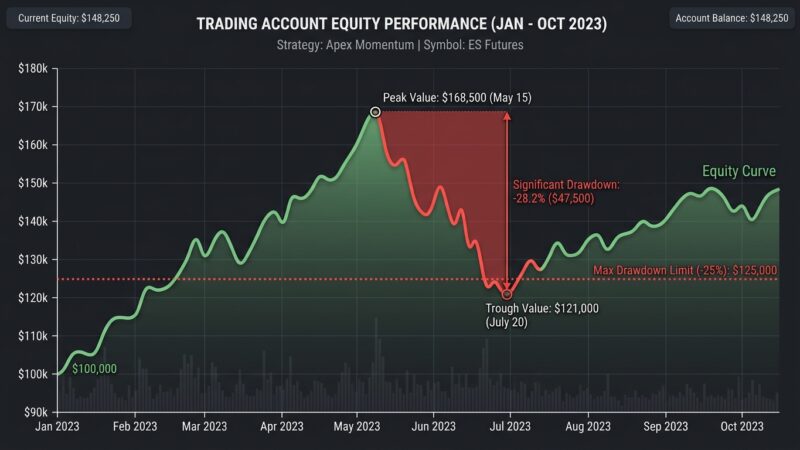
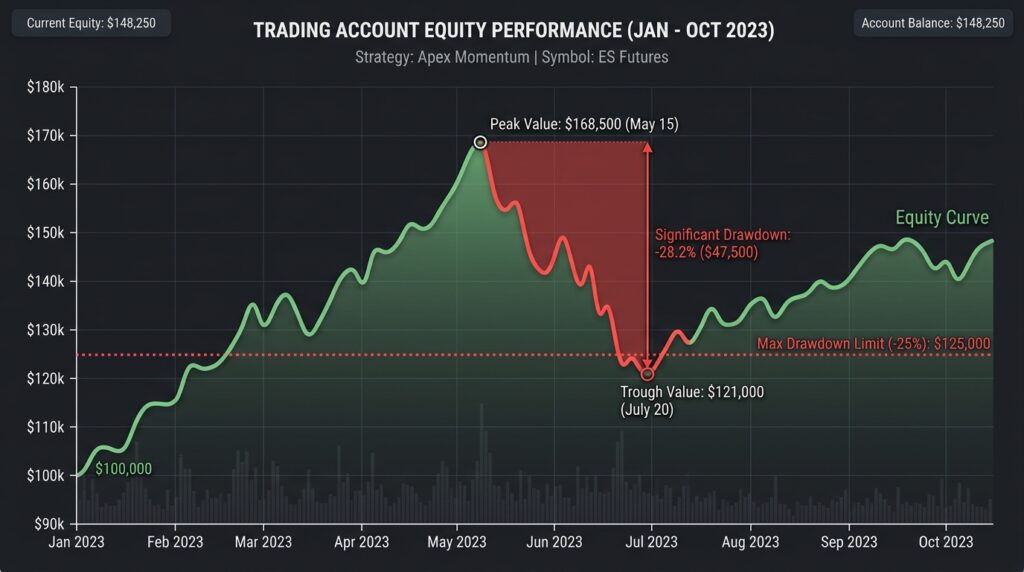
Drawdown is the decline in your trading account from its peak value to its lowest point over a specific period. It is expressed as a percentage.
Formula:
Drawdown % = (Peak Value − Trough Value) ÷ Peak Value × 100Example:
- Your account reaches a peak of ₹1,50,000
- It then falls to ₹1,05,000 before recovering
- Drawdown = (1,50,000 − 1,05,000) ÷ 1,50,000 × 100 = 30%
Max Drawdown is the largest single drawdown your account has experienced — the biggest peak-to-trough decline in your trading history.
Max Drawdown Limit is the maximum drawdown you are willing to allow before taking specific protective action — reducing size, stopping trading, or reviewing your approach entirely.
The distinction between what has happened historically and what you will allow going forward is critical. Max drawdown as a historical measurement tells you about your past. Max drawdown limit as a forward-looking rule protects your future.
Why Most Retail Traders Never Set Drawdown Limits
There are three main reasons traders skip this crucial step:
Overconfidence in recovery. Most traders believe that if they lose money, they will simply make it back. What they do not account for is the mathematics of recovery — which becomes brutally unforgiving as drawdown percentage increases.
No formal trading plan. Drawdown limits require a written, rule-based trading plan. Most retail traders trade reactively without any formal plan. Without a plan, there are no limits. Without limits, there is no floor beneath which the account cannot fall.
Emotional resistance to accepting loss. Setting a max drawdown limit means accepting in advance that there is a level of loss at which you will stop. This acceptance requires confronting the possibility of failure — which many traders psychologically avoid until it is too late.
The Mathematics of Recovery — Why Drawdown Is Deadlier Than You Think
This is the section that changes how most traders think about drawdown forever. The mathematics of recovery from a drawdown are not linear — they are exponential. And they become progressively more punishing as the drawdown deepens.
Study this table carefully:
| Drawdown | Recovery Required |
|---|---|
| 10% loss | 11.1% gain to recover |
| 20% loss | 25% gain to recover |
| 30% loss | 42.9% gain to recover |
| 40% loss | 66.7% gain to recover |
| 50% loss | 100% gain to recover |
| 60% loss | 150% gain to recover |
| 70% loss | 233% gain to recover |
| 80% loss | 400% gain to recover |
| 90% loss | 900% gain to recover |
Read that table again slowly.
If your account drops 50% — you need to double your remaining capital just to get back to where you started. If your account drops 70% — you need to more than triple it. If it drops 90% — you need a 900% gain on what remains.
These recovery requirements are not just difficult. For most retail traders, they are practically impossible — because the psychological damage of a deep drawdown destroys the disciplined execution needed to generate those returns.
A trader who has lost 70% of their account is not thinking clearly. They are desperate, emotional, and likely to take the exact kinds of oversized, reckless risks that will complete the account destruction.
This is why preventing deep drawdowns is infinitely more important than recovering from them.
The Three Levels of Max Drawdown Limits
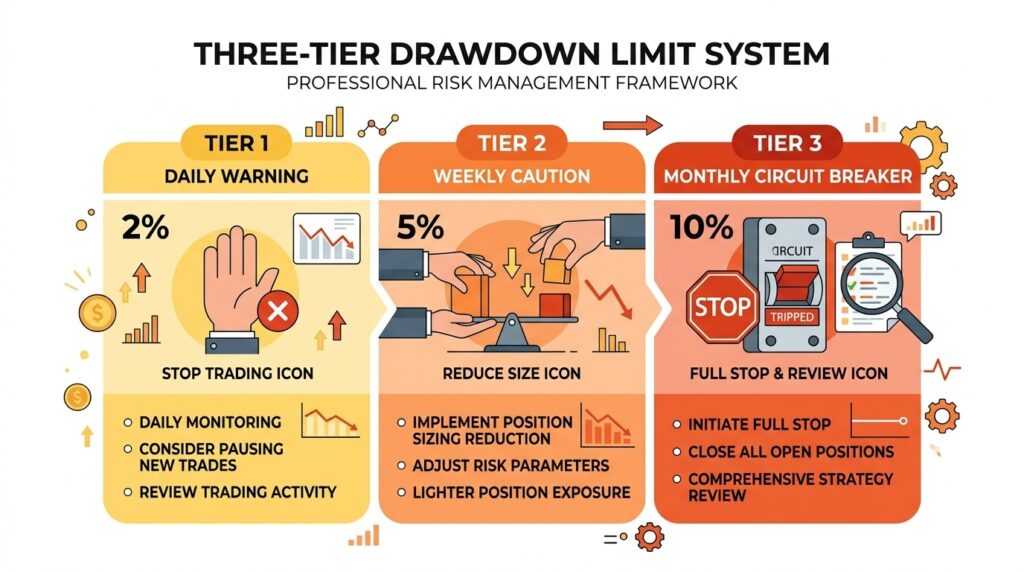
Professional traders and trading firms typically use a three-tier drawdown limit system. Each tier triggers a specific, predetermined response.
Tier 1 — Warning Level (Daily Drawdown Limit)
This is your daily loss limit — the maximum you will lose in a single trading session before stopping completely.
Recommended: 1% to 2% of total account per day
Action when triggered: Stop trading for the day. Close all positions. Do not return to the screen until the next session.
This tier prevents a bad day from becoming a catastrophic day. Every trader has bad days. The question is whether a bad day costs you 1-2% or 10-15%.
Tier 2 — Caution Level (Weekly Drawdown Limit)
This is your weekly loss limit — the maximum drawdown from your account peak you will allow in any rolling 7-day period.
Recommended: 3% to 5% of total account per week
Action when triggered: Reduce position size by 50% for the remainder of the week. Review all trades taken during the week for rule violations before continuing.
This tier catches losing streaks before they become serious damage. Three or four bad days in a row are a signal — either market conditions have changed, your strategy is not working in current conditions, or your execution has broken down. Tier 2 forces you to acknowledge this signal and respond with reduced risk.
Tier 3 — Circuit Breaker Level (Monthly Drawdown Limit)
This is your monthly loss limit — the maximum drawdown from your account peak you will allow in any rolling 30-day period.
Recommended: 6% to 10% of total account per month
Action when triggered: Stop all live trading immediately. Take a minimum 5 to 10 day complete break from markets. Conduct a full review of every trade taken during the drawdown period. Only return to live trading after identifying the specific cause of the drawdown and making concrete adjustments.
This is the most important tier. A 10% monthly drawdown that is stopped and addressed is recoverable. A 10% drawdown that continues unchecked for three months becomes a 30% drawdown — which requires a 43% gain just to break even.
How to Calculate Your Personal Max Drawdown Limits
The specific percentages above are starting guidelines. Your personal limits should be calibrated to three factors:
Factor 1 — Your Strategy’s Historical Performance
If you have traded your strategy for at least 100 trades and have performance data, look at your historical maximum drawdown. Your forward-looking drawdown limit should be set at approximately 1.5× your historical maximum drawdown.
Example: If your strategy’s worst historical drawdown was 8% — set your monthly circuit breaker at 12%. This gives your strategy room to perform within its normal parameters while still catching abnormal deterioration.
If you do not have historical data yet — use the conservative default limits above until you build a track record.
Factor 2 — Your Account Size and Financial Situation
A trader for whom the trading account represents their entire savings needs tighter drawdown limits than a trader for whom the account is discretionary capital they can afford to lose.
Tighter personal financial situation = tighter drawdown limits = smaller position sizes = slower account growth but vastly better survival probability.
Factor 3 — Your Psychological Tolerance
Be honest with yourself. At what level of drawdown does your decision-making deteriorate? At what loss level do you start revenge trading, overriding stops, or making desperate decisions?
For most traders, psychological deterioration begins somewhere between 15% and 25% drawdown. Your circuit breaker should be set well before this level — because the goal is to stop the drawdown before it reaches the point where your psychology is compromised.
Setting Up Your Drawdown Limit Tracking System
Knowing your limits is only useful if you actually track your drawdown in real time. Here is a simple system to implement immediately.
The Peak Equity Tracker
Create a simple spreadsheet — in Excel or Google Sheets — with these columns:
| Date | Starting Balance | Closing Balance | Daily P&L | Account Peak | Current Drawdown % |
|---|
Formula for Account Peak: In the Account Peak column, use: =MAX($C$2:C2) — this automatically updates your all-time peak as the account grows.
Formula for Current Drawdown %: =(E2-C2)/E2*100 — this shows your current drawdown from peak as a live percentage.
Update this sheet every single day after market close. When your Current Drawdown % approaches any of your three tier limits — you have advance warning before the limit is actually breached.
The Daily Check Ritual
Every morning before trading, check three numbers:
- How far am I from my daily loss limit?
- How far am I from my weekly loss limit?
- How far am I from my monthly circuit breaker?
These numbers should be as automatic and non-negotiable as checking the weather before going outside. They define the boundaries within which you operate that day.
The Prop Firm Model — What Professional Trading Firms Teach Us
Proprietary trading firms — companies that fund traders to trade their capital — have some of the most sophisticated drawdown limit systems in the world. Understanding their approach gives retail traders a proven framework to adapt.
Most prop firms operate with rules similar to these:
Daily Loss Limit: Typically 4% to 5% of funded account. Breach this once — trading is suspended for the day automatically by the platform.
Maximum Drawdown: Typically 8% to 12% of funded account from the starting balance. Breach this — the trader’s account is terminated and they must restart the evaluation process.
Trailing Drawdown: Some firms use a trailing maximum drawdown that follows the account equity upward but never comes down. This means as you make profits, your floor rises — preventing you from giving back gains beyond a certain threshold.
The reason prop firms use these rules is simple: they have learned through experience exactly what level of drawdown correlates with trading breakdown. Their limits are not arbitrary — they are calibrated to the point at which a trader’s decision-making becomes unreliable.
Retail traders should treat their own accounts with the same discipline that prop firms apply to funded traders. You are, in effect, the fund manager of your own capital. Manage it accordingly.
What to Do When You Hit Your Circuit Breaker
Most articles tell you to set drawdown limits. Very few tell you what to actually do when you hit them. This is where most traders fail even when they have limits in place — because they set the limit but not the response protocol.
Here is a complete response protocol for when your monthly circuit breaker is triggered:
Step 1 — Stop Immediately and Accept the Reality
The moment your monthly limit is hit — stop trading. Not tomorrow. Not after one more trade to try to recover. Now.
This requires genuine psychological acceptance that the month is over from a live trading perspective. This is difficult. Do it anyway.
Step 2 — Take a Complete Break — Minimum 5 Days
No charts. No paper trading. No watching the market. A genuine mental reset.
This break is not punishment. It is maintenance. Your trading mind needs recovery time just as your body needs rest after physical exertion. A trader who goes straight from a significant drawdown back into live markets without rest almost always makes the drawdown worse.
Step 3 — Conduct a Full Trade-by-Trade Post-Mortem
After your break, sit down with your trading journal and review every trade from the drawdown period. For each trade, answer:
- Did I follow my entry rules exactly?
- Was my stop loss placed correctly at entry?
- Did I respect my daily loss limit every day?
- Did I overtrade — take more trades than my plan allows?
- Were there specific days where I broke multiple rules?
Be ruthlessly honest. The purpose is not to feel bad. The purpose is to identify the specific, concrete causes of the drawdown so you can address them before returning to live trading.
Step 4 — Identify Whether This Is Strategy Failure or Execution Failure
As discussed in previous articles — this distinction is crucial. A drawdown caused by poor execution requires behavioral correction. A drawdown caused by genuine strategy failure requires strategy review and adjustment.
Most drawdowns at the retail level are execution failures. But confirm this through your post-mortem analysis rather than assuming it.
Step 5 — Return With Reduced Size
When you return to live trading after a circuit breaker event, start at 25% to 50% of your normal position size. Rebuild your confidence and your track record before returning to full size.
There is no shame in trading small. There is enormous long-term cost in trading full size before you have re-established disciplined execution after a drawdown.

Max Drawdown Limits for Different Account Sizes — Quick Reference
| Account Size | Daily Limit | Weekly Limit | Monthly Circuit Breaker |
|---|---|---|---|
| ₹25,000 | ₹500 (2%) | ₹1,250 (5%) | ₹2,500 (10%) |
| ₹50,000 | ₹1,000 (2%) | ₹2,500 (5%) | ₹5,000 (10%) |
| ₹1,00,000 | ₹2,000 (2%) | ₹5,000 (5%) | ₹10,000 (10%) |
| ₹2,00,000 | ₹4,000 (2%) | ₹10,000 (5%) | ₹20,000 (10%) |
| ₹5,00,000 | ₹10,000 (2%) | ₹25,000 (5%) | ₹50,000 (10%) |
Print this table. Keep it at your trading desk. Know your numbers before the market opens every single day.
The Mindset Behind Max Drawdown Limits
Setting and following max drawdown limits requires a fundamental mindset shift that many traders struggle with.
It requires accepting that capital preservation is more important than profit maximization — especially in the short term.
It requires accepting that some months will be losing months — and that is acceptable, as long as the loss is controlled and within your limits.
It requires accepting that stopping when you hit your limit is not quitting — it is the most professional decision a trader can make.
The traders who build lasting, sustainable trading careers are not the ones who never have drawdowns. They are the ones who never allow a drawdown to become a wipeout. They are the ones who hit their limit, stop, recover, and come back — again and again — with their capital and their psychology intact.
That resilience — built on the foundation of clear, non-negotiable drawdown rules — is what separates traders who are still trading five years from now from those who blew their accounts in year one.
Final Thoughts
A max drawdown limit is not a restriction on your trading. It is a guarantee that you will still be able to trade tomorrow, next month, and next year.
The market will always be there. Opportunities will always come. But only if you protect the capital that allows you to take them.
Set your three tiers today. Build your tracking spreadsheet this week. Write your response protocol before you need it. And commit to following these rules with the same non-negotiable discipline you would apply to any stop loss on any trade.
Because the most important stop loss you will ever set is not on a single trade. It is on your entire account.
Protect the account. The profits will follow.