Many beginners hear traders saying “I follow 1:2 risk reward”, but they do not clearly understand the 1:2 risk reward meaning. As a result, they apply it incorrectly and still face losses.
Risk–reward ratio is not a guarantee of profit. It is a risk management tool that helps traders survive long-term. This article explains what 1:2 risk reward really means, how it is used in real trading, and why it is important for beginners.
What Is Risk–Reward Ratio?
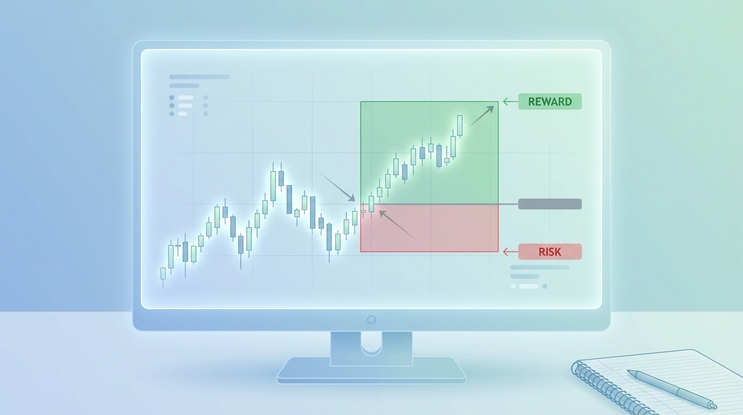
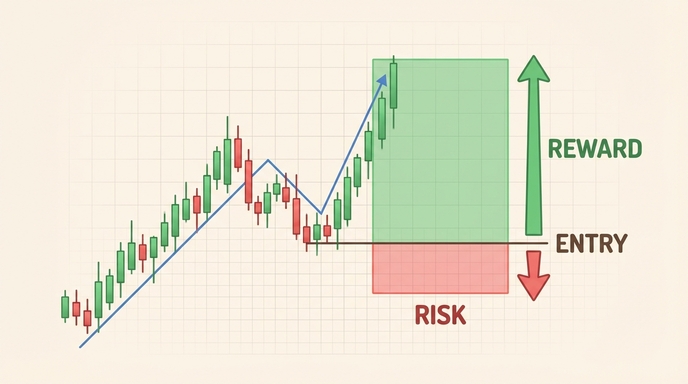
Risk–reward ratio compares:
- How much you are risking
- How much you are expecting to gain
It is written as:
Risk : Reward
Example:
- Risk = ₹100
- Reward = ₹200
This is called 1:2 risk reward.
It means:
For every ₹1 you risk, you aim to earn ₹2.
Table of Contents
What Does 1:2 Risk Reward Mean?
The 1:2 risk reward meaning is simple:
- If your stop loss is ₹100
- Your target should be at least ₹200
This ratio helps ensure that:
- Small losses are controlled
- Winning trades compensate for losing trades
Risk–reward focuses on long-term consistency, not single trades.
Simple Numerical Example
Let’s understand with a simple example.
You take 10 trades:
- 5 trades hit stop loss (₹100 loss each)
- 5 trades hit target (₹200 profit each)
Total loss:
5 × 100 = ₹500
Total profit:
5 × 200 = ₹1000
Net result:
₹1000 – ₹500 = ₹500 profit
Even with 50% accuracy, you are profitable because of 1:2 risk reward.
Why 1:2 Risk Reward Is Important for Beginners
Beginners often focus on:
- Winning percentage
- Number of trades
- Daily profit
Professionals focus on:
- Risk control
- Risk–reward ratio
- Consistency
1:2 risk reward helps beginners:
- Avoid big losses
- Reduce emotional pressure
- Stay disciplined
- Survive losing streaks
Risk–Reward Is More Important Than Accuracy
This is a hard truth for beginners.
Example:
- Trader A: 70% accuracy but 1:0.5 risk reward
- Trader B: 40% accuracy but 1:2 risk reward
Trader B can still be profitable, while Trader A may lose money.
Accuracy alone does not decide success. Risk–reward does.
How to Calculate 1:2 Risk Reward in a Trade
Step-by-step process:
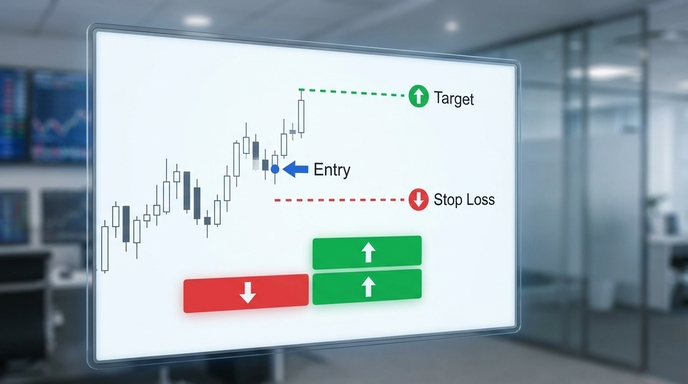
- Identify entry price
- Decide stop loss logically
- Measure stop loss distance
- Set target double the stop loss distance
Example:
- Entry: ₹500
- Stop loss: ₹490 (₹10 risk)
- Target: ₹520 (₹20 reward)
This is a perfect 1:2 setup.
Common Beginner Mistakes With Risk Reward
Many beginners misunderstand risk reward.
Mistake 1: Changing Target Emotionally
They reduce target early due to fear.
Mistake 2: Moving Stop Loss
They increase risk to avoid loss.
Mistake 3: Forcing 1:2 Setup
Not every trade offers 1:2. Skipping trades is okay.
Mistake 4: Ignoring Market Structure
Risk reward should be based on support and resistance, not random numbers.
Does 1:2 Risk Reward Guarantee Profit?
No.
Important reality:
- Some trades will fail
- Some trades will hit stop loss
- Losing streaks will happen
1:2 risk reward does not prevent losses, but it:
- Limits damage
- Improves long-term expectancy
When 1:2 Risk Reward Does Not Work
1:2 risk reward fails when:
- Stop loss is random
- Entry is poor
- Trade is taken against trend
- Market is very choppy
Risk reward works only when combined with:
- Good entries
- Proper analysis
- Discipline
Is Higher Risk Reward Always Better?
No.
Higher ratios like:
- 1:3
- 1:4
Have:
- Lower hit rate
- More missed targets
For beginners:
- 1:2 is balanced
- Easy to follow
- Practical in most markets
Risk Reward vs Profit Obsession
Beginners focus on:
- “How much I can earn”
Professionals focus on:
- “How much I can lose”
Risk reward keeps focus on process, not greed.
Best Timeframes to Use 1:2 Risk Reward
1:2 risk reward works well on:
- 15-minute charts
- 1-hour charts
- Daily charts
Lower timeframes:
- More noise
- Harder to maintain discipline
Reality Check for Beginners
Risk reward:
- Does not make trading easy
- Does not remove losses
- Does not replace strategy
But without risk reward:
- Trading becomes gambling
- Losses become uncontrollable
Final Conclusion
The 1:2 risk reward meaning is not about earning double money every time. It is about protecting capital and staying profitable over many trades.
By risking less and aiming for reasonable rewards, traders give themselves a mathematical edge. Beginners who understand and apply 1:2 risk reward correctly improve survival, discipline, and long-term consistency.