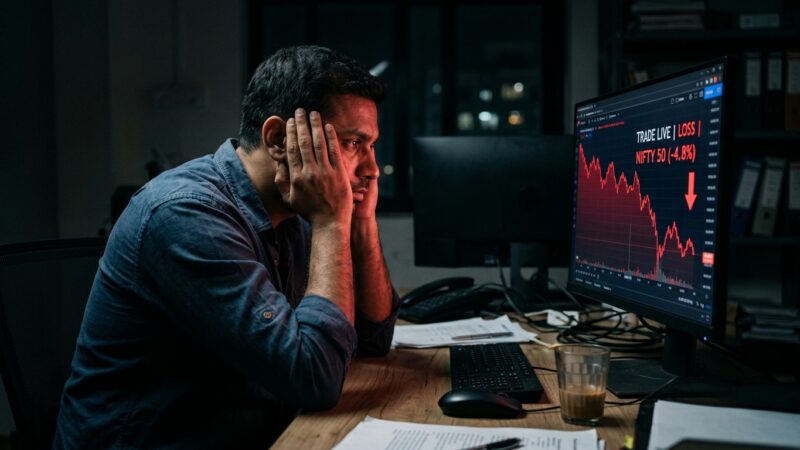
Every trader — no matter how experienced, no matter how disciplined — will face a drawdown. A period where losses pile up, confidence disappears, and the account balance drops to a level that feels deeply uncomfortable or even devastating.
What separates traders who survive drawdowns from those who quit or blow their accounts is not strategy. It is psychology.
Dealing with drawdowns is one of the most important — and least discussed — skills in trading. This article covers what drawdowns actually are, why they hit so hard psychologically, and a step-by-step framework for recovering mentally and financially after big losses.
What Is a Drawdown in Trading?
A drawdown is the decline in your trading account from its highest point to its lowest point over a specific period. It is measured in percentage or absolute value.
For example — if your account was at ₹1,00,000 and drops to ₹70,000, you are in a 30% drawdown.
Drawdowns are completely normal in trading. Every professional trader, every hedge fund, every trading algorithm experiences drawdowns. They are not a sign that your strategy is broken or that you are a bad trader.
But knowing this intellectually and actually feeling okay during a drawdown are two very different things.
Why Drawdowns Hit So Hard Psychologically
The financial loss is painful. But the psychological damage of a drawdown goes much deeper than just money.
1. Identity Crisis
For many traders — especially those who trade full-time or are deeply invested in the identity of being a trader — a big loss or losing streak triggers an identity crisis. The question stops being “why did this trade fail” and becomes “am I actually good enough to do this?”
This is one of the most dangerous psychological states a trader can be in. Because when your sense of self-worth is tied to your P&L, every loss becomes personal.
2. Loss Aversion Amplification
Behavioral finance research consistently shows that humans feel the pain of a loss roughly twice as intensely as the pleasure of an equivalent gain. This means a ₹10,000 loss hurts approximately twice as much as a ₹10,000 profit feels good.
During a drawdown — when losses are stacking — this psychological pain multiplies rapidly. It becomes overwhelming and starts distorting decision-making in ways the trader often does not even notice.
3. Broken Confidence Loop
Confidence in trading is built through a track record of disciplined execution. A drawdown — especially a sudden, large one — breaks this confidence loop.
The trader starts second-guessing every valid setup. They hesitate on entries. They exit winners too early because they are terrified of another loss. Ironically, this fear-based trading creates more losses, which destroys confidence further. It becomes a self-reinforcing cycle that is very hard to break without deliberate intervention.
4. Social and Financial Pressure
For Indian traders especially, there is often external pressure that makes drawdowns even harder. Family members who were skeptical about trading from the beginning now feel validated. Money that was meant for something else is now gone. The social weight of having to explain losses to a spouse, parent, or friend adds enormous psychological burden on top of the already-difficult financial reality.

The 5 Stages Traders Go Through During a Drawdown
Just like grief, drawdowns have recognizable psychological stages. Understanding which stage you are in helps you respond appropriately instead of reactively.
Stage 1 — Denial
“This is just a temporary dip. My strategy still works. The market will turn.”
In this stage, the trader minimizes the drawdown and continues trading as normal — sometimes even increasing position size to recover faster. This is the most dangerous stage because action continues without acknowledgment of the problem.
Stage 2 — Frustration and Anger
“Why does this keep happening to me? The market is manipulated. My broker is against me.”
Blame shifts outward. The trader becomes irritable, impulsive, and emotionally reactive. Revenge trading peaks in this stage. More losses follow.
Stage 3 — Bargaining
“If I just change this one indicator, if I just use a different timeframe, if I just try this new strategy — it will work.”
The trader starts frantically searching for external fixes — new courses, new strategies, new tools. This is an avoidance mechanism. The real issue — psychological and behavioral — is not being addressed.
Stage 4 — Depression and Withdrawal
“Maybe trading is not for me. I have wasted so much time and money. I should just quit.”
This stage often involves stepping away from markets entirely — sometimes for weeks. While rest is genuinely needed, complete withdrawal without reflection means the lessons of the drawdown are never learned.
Stage 5 — Acceptance and Rebuilding
“This happened. I need to understand why and build back systematically.”
This is where real recovery begins. The trader stops fighting the reality of the loss and starts working with it constructively. This is the stage to aim for — as quickly and consciously as possible.
Dealing With Drawdowns — A Step-by-Step Recovery Framework
Step 1: Stop Trading Immediately
The first and most important step when you recognize you are in a significant drawdown is to stop trading.
Not reduce trading. Stop.
This is counterintuitive. Every instinct says to get back in and recover the losses. But continuing to trade while you are psychologically damaged — scared, angry, desperate — is like driving a car with a broken windshield. You cannot see clearly. You will crash again.
Give yourself a minimum of 3 to 7 days away from live markets. No charts, no P&L checking, no trading apps. A complete reset.
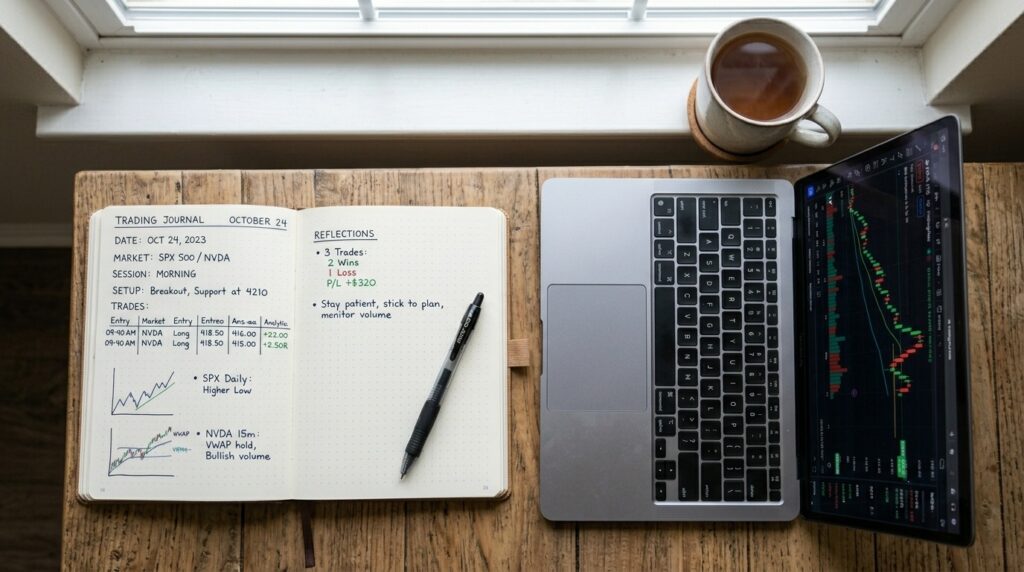
Step 2: Do a Cold, Honest Post-Mortem
Once you have created some emotional distance, sit down and analyze the drawdown objectively. Ask these questions:
- Was this drawdown caused by market conditions outside my strategy’s parameters?
- Did I follow my rules during this period — or did I deviate?
- Was my position sizing appropriate throughout?
- Were there specific trades that caused most of the damage? Why did I take them?
- Is my strategy actually broken — or did I execute it poorly?
Be brutally honest. This analysis is not about self-punishment. It is about understanding the actual cause so you can address the actual problem.
Step 3: Separate Strategy Failure from Execution Failure
This is one of the most important distinctions in dealing with drawdowns — and most traders skip it entirely.
There are two very different reasons a drawdown can happen:
Strategy failure means your actual edge in the market has stopped working. The market conditions have changed and your approach no longer has a statistical advantage. This requires strategy review and adjustment.
Execution failure means your strategy is fine but you did not follow it. You took trades that were not in your plan, you ignored stop losses, you overtraded, you sized positions too large. The strategy was not the problem — you were.
Most drawdowns in retail trading are caused by execution failure, not strategy failure. Identifying which one you are dealing with determines your entire recovery path.
If it is execution failure — you do not need a new strategy. You need to recommit to your existing rules with better discipline.
If it is strategy failure — you need a period of paper trading and backtesting before returning to live markets.
Step 4: Rebuild With Drastically Reduced Position Size
When you return to live trading after a drawdown, do not come back at your normal position size. Come back at 25% to 50% of your normal size.
This serves two purposes. First, it limits financial damage during the rebuilding phase when your confidence and decision-making are still fragile. Second, it creates a low-pressure environment where you can rebuild the habit of disciplined execution without the emotional weight of large sums.
Many traders resist this step because it feels like a step backward. It is not. It is the most professional thing you can do. Protect the capital that remains. Rebuild slowly.
Step 5: Focus Entirely on Process for 30 Days
For the first 30 days after returning from a drawdown, remove P&L from your daily evaluation entirely. Your only question at the end of each trading day should be:
“Did I follow my rules today?”
If yes — successful day. If no — what specifically went wrong and why?
This process-focused approach rebuilds the confidence loop that the drawdown destroyed. You start creating evidence that you can trade with discipline again. That evidence — not luck, not a big winning trade — is what restores real trading confidence.
Step 6: Address the Mental Health Component Honestly
This step is almost never discussed in trading content — but it needs to be.
Big financial losses have real mental health consequences. Anxiety, sleep disruption, inability to concentrate, relationship strain, feelings of worthlessness — these are not weakness. They are normal human responses to significant financial stress.
If you are experiencing these symptoms seriously, speaking to a professional — a therapist, a counselor, or even a trading psychologist — is not a sign of failure. It is a sign of self-awareness and seriousness about your long-term performance.
Your mental health is the foundation of your trading performance. You cannot build a sustainable trading career on a broken psychological foundation.
What Professional Traders Do Differently During Drawdowns
The difference between amateur and professional traders during drawdowns is not that professionals feel no pain. They feel it too. The difference is in their response.
Professional traders have pre-defined drawdown rules — written into their trading plan before the drawdown even happens. For example: “If I lose more than 10% of my account in any single month, I will reduce position size by 50% for the following month. If I lose more than 20%, I will stop trading for two weeks and review my approach.”
These rules exist because the professional knows that drawdowns will come. They plan for them in advance — when they are thinking clearly — so that when the emotional storm hits, the plan is already there.
Amateur traders have no such rules. They make decisions reactively, in the middle of the emotional storm, when their judgment is most compromised.

A Note for Indian Traders Specifically
In India, there is significant social stigma around financial loss. Many traders hide their losses from family members for months or years. This isolation makes the psychological recovery from drawdowns dramatically harder.
If you are in a drawdown, find at least one person you can be honest with — a trading friend, an online community, or a mentor. You do not need to broadcast your losses. But you need at least one honest conversation with someone who understands trading.
Isolation during a drawdown is one of the most dangerous things a trader can do to themselves.
The Indian trading community — despite its competitive surface — has many experienced traders who have been through exactly what you are going through. Seek them out. Learn from their experience. You do not have to figure this out alone.
Final Thoughts
Drawdowns are not the end of the story. For every successful trader alive today, there is a drawdown story somewhere in their past — sometimes multiple devastating ones.
What made them successful was not avoiding drawdowns. It was how they dealt with them.
They stopped. They reflected. They rebuilt slowly and deliberately. They came back with better rules, better self-awareness, and — most importantly — a deeper respect for risk.
Dealing with drawdowns is ultimately about one thing: choosing to treat the loss as a teacher rather than a verdict.
The market did not fail you. It taught you something — often something expensive. Your job now is to make sure you learned it.