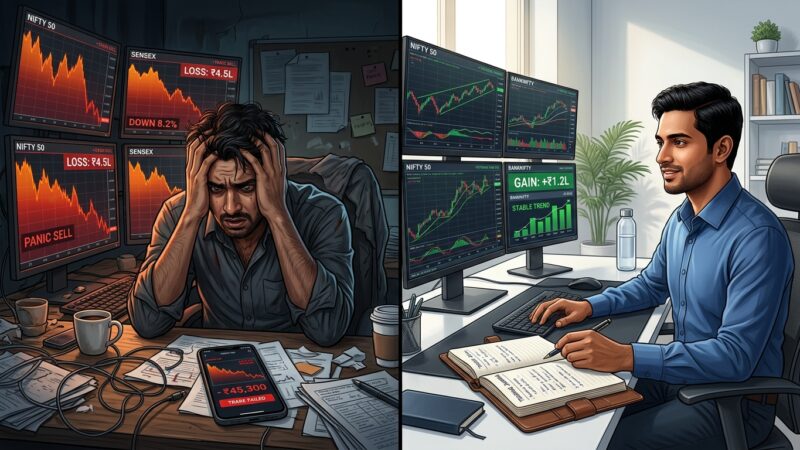
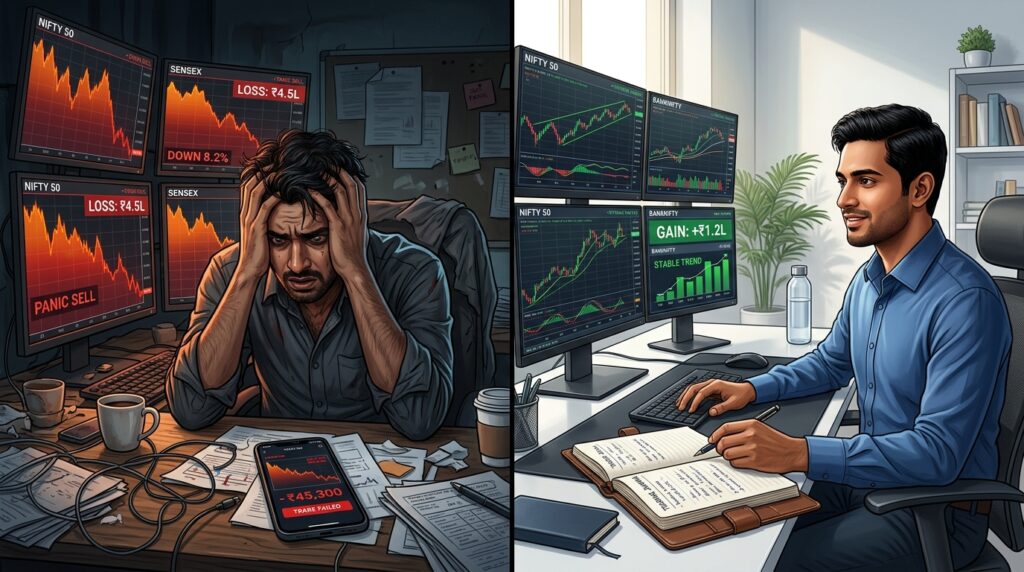
Every trader starts somewhere. For most Indian traders, that starting point looks something like this — a friend made quick money in the market, you opened a Zerodha or Groww account, deposited some money, and started buying and selling stocks based on tips, YouTube videos, or just gut feeling.
Within weeks or months, the account was down. Significantly.
Sound familiar?
This is not a failure story. This is actually the beginning of a very important journey — the journey of trading mindset shift. The shift from thinking like a gambler to operating like a professional. And it is the single most important transition any trader can make.
This article shares real patterns from Indian traders — the mistakes, the turning points, and the exact mindset changes that separated those who quit from those who finally became consistent.
What Is a Gambling Mindset in Trading?
Before we talk about the shift, we need to understand what a gambling mindset actually looks like in trading. Because most traders with a gambling mindset do not even realize they have one.
A gambling mindset in trading shows up like this:
- You enter trades based on tips from Telegram groups or social media
- You do not use stop loss because “it will recover”
- You average down on losing positions hoping the price comes back
- You hold winning trades too long out of greed and lose the profits
- You feel a rush when you enter a trade — excitement, not calmness
- After a loss, you immediately take another trade to “recover”
- You measure success by single-day profits, not consistency over months
The core of the gambling mindset is this: you believe the market owes you money. You believe if you just try hard enough, stay long enough, or get lucky enough — you will win.
The market does not work that way. And until a trader truly understands this, no strategy, no indicator, and no course will save their account.
Real Story 1 — Rahul from Pune: The Man Who Treated Trading Like a Casino
Rahul was a 26-year-old IT professional from Pune. In 2021, during the post-COVID bull market, he opened a trading account with ₹1.5 lakh. Within three months, he had turned it into ₹2.8 lakh purely by buying stocks that were going up and riding momentum.
He quit his job.
By mid-2022, his account was at ₹40,000.
What happened? When the bull market ended, Rahul’s “strategy” — which was never really a strategy — stopped working. But instead of stopping, he doubled down. He started doing intraday F&O trading with money borrowed from family. He was averaging down on losing positions. He was watching trading tips channels at 2 AM.
The turning point came when he lost ₹80,000 in a single day on a Bank Nifty trade he did not even fully understand.
That night, instead of opening the app again, he closed it and asked himself one honest question: “Am I trading or am I gambling?”
That question changed everything.
Rahul spent the next six months studying price action, risk management, and trading psychology — without placing a single live trade. He paper traded for three months. He came back to live markets with ₹50,000 and a strict rule: maximum 1% risk per trade, maximum 2 trades per day, no F&O for one full year.
Today Rahul trades part-time alongside a new job. He is not rich. But he is consistent — and for the first time, he actually understands every trade he takes.
The mindset shift: From “how much can I make today” to “how well did I follow my process today.”
Real Story 2 — Priya from Chennai: When Losing Everything Became the Best Teacher
Priya was a homemaker in Chennai who started trading in 2020 with ₹50,000 that she had saved over years. She had seen her neighbor make money in stocks and thought she could do the same.
For the first few months, she followed tips religiously — from a paid Telegram channel that charged ₹5,000 per month for “sure-shot calls.” She made some money. She felt confident.
Then the tips started failing. She held losing trades because the “expert” said to hold. Her ₹50,000 became ₹18,000 in less than a year.
The most important moment in Priya’s story was not the loss. It was what she did next.
Instead of leaving the market angry, she got curious. She asked: “Why did I trust someone else’s analysis completely without understanding it myself?”
She started from zero. She learned what support and resistance actually mean. She learned how to read a basic chart. She learned why stop loss is not optional.
More importantly, she learned this truth: no one — no Telegram channel, no YouTube expert, no paid service — cares more about your money than you do.
Priya now trades with a small capital and makes modest but consistent returns. She follows no tips. She has her own simple strategy with clear rules. And she has not blown an account since.
The mindset shift: From “I need someone to tell me what to do” to “I am responsible for every trade I take.”
Real Story 3 — Vikram from Delhi: The Trader Who Almost Gave Up
Vikram had been trading for four years and was still losing. Not big dramatic losses — just slow, consistent, painful losses. Every month he would end slightly negative. He had tried three different strategies, two trading courses, and countless indicators.
He was ready to quit.
Before he did, a mentor told him something that changed his perspective completely: “Stop looking for a better strategy. Start looking at how you execute the strategy you already have.”
Vikram went back and reviewed six months of his trades. What he found was uncomfortable. His strategy was actually profitable — on paper. But in real execution, he was:
- Exiting winners too early out of fear
- Holding losers too long out of hope
- Skipping valid setups because he “had a bad feeling”
- Taking invalid setups because he was bored
The strategy was not the problem. He was the problem.
This was Vikram’s turning point. He realized that trading psychology was not a soft topic for motivational videos. It was the actual reason he was losing money.
He started journaling every trade — not just the numbers, but the emotions. He hired a trading coach for three months. He worked on his exit discipline specifically.
Within a year, the same strategy that was losing money started performing. Nothing changed except the person executing it.
The mindset shift: From “I need a better strategy” to “I need to become a better trader.”
The 5 Core Mindset Shifts That Separate Gamblers from Professionals
These are not motivational lines. These are practical, operational changes in how a trader thinks and acts every single day.
Shift 1: From Outcome Focus to Process Focus
A gambler measures success by whether they made money today. A professional measures success by whether they followed their rules today.
This is not just philosophy — it is practical. Markets are random in the short term. You can follow your rules perfectly and still lose a trade. You can break every rule and still win a trade. Judging yourself by outcome alone teaches you nothing and destroys your psychology.
Judge yourself by process. Did you follow your plan? Did you respect your stop loss? Did you stay within your trade limit? If yes — that was a good day, even if the P&L is red.
Shift 2: From Hoping to Planning
Gamblers hope. Professionals plan.
Before entering any trade, a professional already knows: what is my entry, what is my stop loss, what is my target, and what is my position size. There is no hope involved. Just a plan with defined risk.
Hope is not a trading strategy. A plan is.
Shift 3: From Ego to Accountability
Losing traders blame the market, their broker, their internet connection, the news — everything except themselves. Winning traders take full accountability.
The market is never wrong. You were either right or wrong. Your analysis worked or it did not. This is not harsh — this is the mindset that creates actual improvement.
When you stop blaming and start analyzing, you start growing.
Shift 4: From Short-Term Thinking to Long-Term Thinking
A gambler thinks about today’s profit. A professional thinks about this month’s performance, this quarter’s consistency, this year’s growth.
Individual trades mean almost nothing. What matters is your edge applied consistently over hundreds of trades. One bad trade is irrelevant. One bad month is a data point. Your job is to execute your edge — again and again — and let statistics work in your favor.
Shift 5: From Excitement to Boredom
This one surprises people. Professional trading is actually quite boring.
You wait for your setup. It either appears or it does not. You take the trade or you do not. You manage it according to your rules. You close it. You journal it. You wait again.
There is no rush. No thrill. No gambling high.
If trading feels exciting and thrilling to you right now — that is actually a warning sign, not a good thing. The excitement means emotions are running the show. Professionals find their edge in calm, boring, disciplined execution — not in the rush of random action.
How to Start Your Own Mindset Shift Today
Reading about mindset is one thing. Actually changing is another. Here are three concrete steps you can take today:
Step 1 — Audit your last 20 trades. Write down the actual reason you entered each one. Be brutally honest. How many had a clear, rule-based reason? How many were impulsive, boredom-driven, or tip-based?
Step 2 — Write your trading rules. Not a vague “I will be disciplined.” Specific rules: maximum trades per day, entry criteria, stop loss policy, daily loss limit. If you do not have written rules, you are gambling — regardless of what you believe.
Step 3 — Start a trading journal. This is non-negotiable for any serious trader. Track every trade, every emotion, every lesson. The journal is where the mindset shift actually happens — not in motivation videos, not in courses — but in the daily, honest reflection on your own behavior.
Final Thoughts
The stories of Rahul, Priya, and Vikram are not unique. Thousands of Indian traders go through the exact same journey every year. The market takes their money first, then — if they are willing to look inward — it gives them something more valuable: self-awareness, discipline, and a real understanding of risk.
The trading mindset shift from gambler to professional is not a one-day event. It is a slow, sometimes painful process of unlearning bad habits and building new ones.
But it is absolutely possible. And it starts with one honest question — the same one Rahul asked himself that night:
“Am I trading — or am I gambling?”