
Ask any consistently profitable trader what their real edge is — and very few will say a specific indicator or strategy. Most will say the same thing: discipline.
Not talent. Not luck. Not a secret system.
Discipline.
But discipline is one of those words that sounds simple and feels impossible. Everyone knows they should be disciplined. Very few actually are — especially in trading, where emotions run high, money is on the line, and the market constantly tempts you to break your own rules.
The truth is that discipline is not a personality trait you either have or you do not. Discipline is a system. It is built through deliberate daily routines, clear rules, and consistent habits practiced over time.
This article gives you the exact discipline rules and daily routines that separate winning traders from losing ones — and a practical framework you can start using from tomorrow.
Why Most Traders Fail at Discipline
Before building the solution, understand the real problem.
Most traders fail at discipline not because they are weak or undedicated. They fail because they try to be disciplined through willpower alone.
Willpower is a limited resource. Research in behavioral psychology consistently shows that willpower depletes throughout the day — each decision, each temptation resisted, each moment of self-control draws from the same mental energy reserve. By afternoon, after hours of watching charts and managing emotions, a trader’s willpower is nearly empty.
This is why the worst trades of the day happen in the afternoon session. This is why traders break their rules when they are tired, frustrated, or had a bad morning. This is why good intentions at the start of the day often collapse by 2 PM.
The solution is not “try harder.” The solution is build systems that make discipline the default — not the effort.
That is exactly what daily routines do.

The Pre-Market Morning Routine — Before You Touch a Single Chart
The most important trading decisions of the day are made before the market opens. Professional traders do not wake up, open Zerodha, and start clicking buttons. They prepare.
Wake Up With Enough Time
Give yourself at least 60 to 90 minutes before market open. Rushing into trading is one of the fastest ways to break discipline. When you are rushed, you skip preparation, you miss key levels, and you enter the market in a reactive state rather than a prepared one.
Physical Movement First
Before looking at any screen — move your body. Even 10 to 15 minutes of walking, stretching, or basic exercise. This is not lifestyle advice. This is performance advice.
Physical movement activates the prefrontal cortex — the part of the brain responsible for rational decision-making, impulse control, and planning. You are literally warming up your decision-making engine before you need it most.
Review Your Trading Plan
Every morning, before markets open, read your trading rules. Not because you have forgotten them — but because repetition reinforces them. Professional athletes review their game plan before every match. Professional traders do the same.
Your trading plan should clearly state your entry criteria, maximum trades per day, daily loss limit, and position sizing rules. Read it. Remind yourself what today’s boundaries are.
Mark Key Levels on the Chart
Spend 20 to 30 minutes marking important support and resistance levels, previous day’s high and low, and any significant price zones relevant to your watchlist. Do this with the market closed — when there is no price movement pulling your attention and triggering emotions.
When the market opens, you already know where the important levels are. You are not discovering them in real time while money is on the line.
Set Your Intentions for the Day
Write down three things in your journal before the market opens:
- What is my maximum loss today before I stop trading?
- What is my maximum number of trades today?
- What is my emotional state right now — and is it suitable for trading?
That third question is critical. If you woke up with a family argument, received bad news, or slept poorly — these emotional states directly impact trading decisions. Acknowledging them before the market opens is the first step to managing them.
During Market Hours — The Rules That Protect You From Yourself
Rule 1: Only Trade Your Pre-Defined Setups
This is the foundation of all trading discipline. You have a setup. It either appears or it does not. If it does not appear — you do not trade.
Write your setup criteria so specifically that there is no room for interpretation. Vague rules create loopholes. Loopholes create impulsive trades. Specific rules create discipline.
For example — not “I trade breakouts” but “I trade breakouts of previous day’s high with volume at least 1.5x the 20-day average, in the first 90 minutes of the session only, when the broader market is trending in the same direction.”
Specificity is discipline.
Rule 2: Set Your Stop Loss Before Entry — Every Single Time
No exceptions. No “I will manage it manually.” No “this one is safe, I do not need a stop.”
Your stop loss is placed the moment you enter the trade. It is not negotiable after entry because after entry, emotions are involved. Before entry, you are thinking rationally. Let your rational pre-entry self protect your emotional post-entry self.
Rule 3: The Daily Loss Limit Is Sacred
Decide a maximum daily loss — typically 1% to 2% of your total capital — and treat it as an absolute boundary, not a guideline.
When you hit your daily loss limit, close the platform. Shut the laptop. Leave the desk. Go for a walk.
This rule alone — if followed consistently — prevents the catastrophic losing days that destroy months of progress in a single session.
Rule 4: Do Not Watch Every Tick
Place your trade, set your stop loss and target, and step back. Watching every single price movement triggers emotional reactions that lead to premature exits, moved stop losses, and impulsive decisions.
Check your trade at defined intervals — for example, every 15 or 30 minutes — rather than continuously. This reduces emotional noise dramatically.
Rule 5: No Trading in the First 15 Minutes
The first 15 minutes of the Indian market session — 9:15 AM to 9:30 AM — are characterized by extreme volatility, gap fills, and institutional order flow that individual traders cannot read accurately. Many beginners lose a significant portion of their capital in these first minutes alone.
Professional discipline means waiting. Let the dust settle. Let the initial volatility play out. The best setups of the day often develop between 9:30 AM and 11:00 AM — after the opening chaos has resolved.
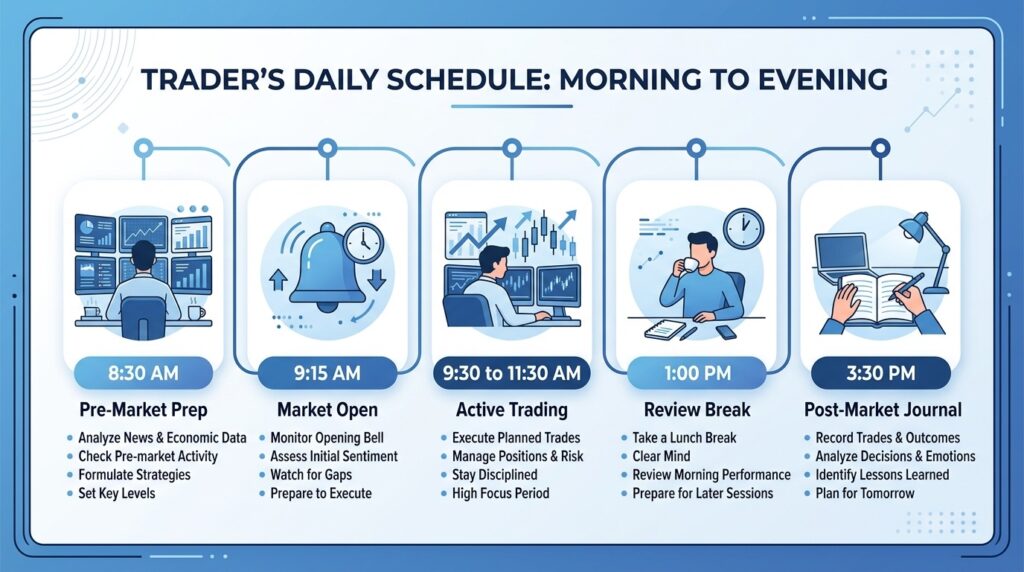
Post-Market Evening Routine — Where Real Growth Happens
Most traders close their last trade and immediately switch off. This is one of the biggest missed opportunities in trading development.
The post-market routine is where losing traders stay losing and improving traders actually improve.
Step 1: Journal Every Trade — Same Day
Within one hour of market close, open your trading journal and record every trade from the day. For each trade, write:
- Entry and exit price
- Setup name and whether criteria were fully met
- Result in rupees and percentage
- Emotional state during the trade — calm, fearful, greedy, bored
- What you did well
- What you could have done better
- One specific lesson from this trade
Do not skip this step because the day was bad. Actually — especially do not skip this step when the day was bad. The most valuable lessons come from losing trades, not winning ones.
Step 2: Review Your Rule Compliance
Go through each trade and ask one question: did I follow my rules on this trade?
Give yourself a simple score — Yes or No for each rule. Did I wait for my setup? Did I place my stop loss immediately? Did I respect my daily loss limit? Did I stay within my trade count limit?
This review is not about punishing yourself for mistakes. It is about creating honest visibility into your actual behavior versus your intended behavior. Over time, this gap closes — and that closing of the gap is exactly what trading discipline looks like in practice.
Step 3: Prepare Tomorrow’s Watchlist
Spend 20 to 30 minutes in the evening identifying stocks or instruments you will watch tomorrow. Mark key levels in advance. Check if there are any major events — earnings, RBI announcements, global cues — that could affect your instruments.
Walk into tomorrow prepared. Not reactive.
Step 4: Disconnect Completely
After your post-market routine is complete — disconnect from trading entirely. No charts, no financial news, no trading group messages late at night.
Your brain needs recovery time. The analysis paralysis and anxiety that many traders feel comes partly from never fully switching off. Rest is not laziness — it is performance management.
Weekly Review — The Habit That Compounds Your Growth
Every weekend, spend 45 to 60 minutes doing a weekly review of your trading. This review should cover:
Performance Review — What was your total P&L for the week? What was your win rate? What was your average risk-reward ratio? Are these numbers consistent with your strategy’s expected performance?
Rule Compliance Review — Looking at the whole week, how consistently did you follow your rules? Which rule did you break most often? Why?
Pattern Identification — Are there patterns in your mistakes? Do you consistently lose on a specific day of the week? Do you overtrade after a winning day? Do you underperform in a specific market condition?
One Improvement Goal — Choose one specific thing to improve next week. Not five things. One. Focused improvement compounds far faster than scattered improvement.
The Discipline Rules Summary — Post This at Your Trading Desk
These are the non-negotiable daily rules for disciplined trading:
Before Market: Complete morning routine before touching charts. Read your trading plan every single morning. Mark key levels with market closed. Set daily loss limit and trade count limit in writing.
During Market: Only trade pre-defined setups. Stop loss placed at entry — always. Stop trading when daily loss limit is hit. No trading in the first 15 minutes. Do not watch every tick.
After Market: Journal every trade same day. Review rule compliance honestly. Prepare next day’s watchlist. Disconnect from trading completely after routine is done.
Weekly: Full performance and behavior review every weekend. Choose one specific improvement goal for next week.
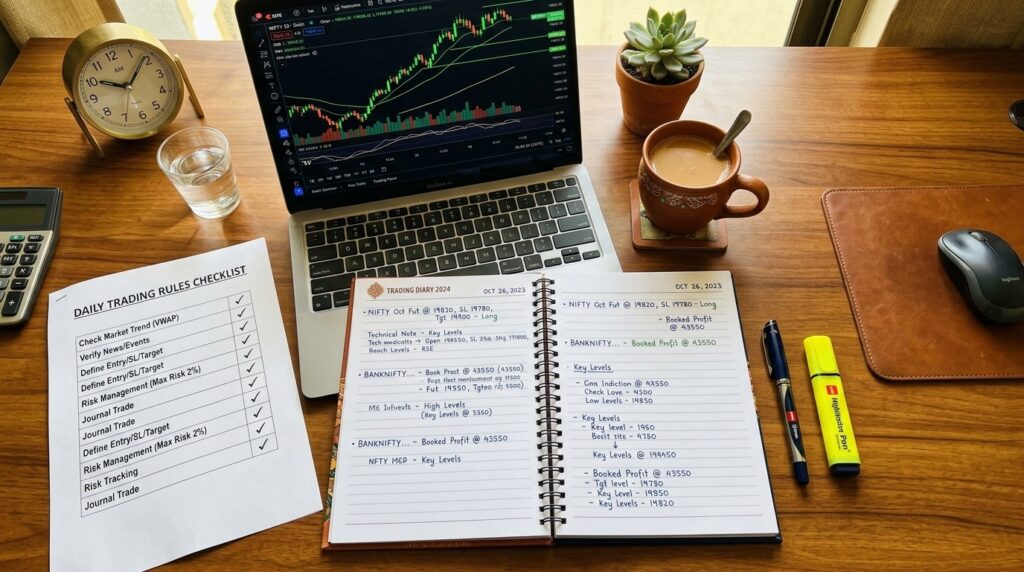
The Compound Effect of Daily Discipline
Here is the most important thing to understand about discipline rules and daily routines in trading:
No single day of following your routine will feel significant. One day of journaling, one day of waiting for your setup, one morning of preparation — none of it feels like it is making a dramatic difference.
But compound it over 30 days, 90 days, 6 months — and the transformation is profound.
The trader who follows these routines consistently for six months is a fundamentally different trader than the one who started. Their decision-making is cleaner. Their emotional reactions are smaller. Their consistency improves. Their confidence is based on evidence, not hope.
Discipline is not a dramatic overnight change. It is the quiet, unglamorous practice of doing the right small things — every single day — until they become who you are.
That is how gamblers become professionals. Not through one big epiphany. Through thousands of small, disciplined choices made one day at a time.
Final Thoughts
The market does not reward intelligence. It does not reward hard work in the conventional sense. It does not reward good intentions or passion or how many YouTube videos you have watched.
The market rewards one thing above everything else: consistent, disciplined execution over time.
Your daily routine is your discipline made concrete. It is the structure that protects you from your own worst impulses and creates the conditions for your best trading to emerge.
Start tomorrow. Not with perfection — but with one routine, followed consistently. The morning preparation. The post-market journal. The weekly review.
Build the habit. Trust the process. The results will follow.