Most traders obsess over entries. Which stock to buy. Which indicator to use. Which setup to follow. But there is one question that matters far more than any of these — and most beginners never ask it:
How much should I risk on this trade?
This single question — answered correctly every single time — is what separates traders who survive long term from those who blow their accounts within months. And the tool that answers this question precisely is called a position sizing calculator.
This article explains exactly what position sizing is, why the 1% rule is the foundation of professional risk management, how to calculate your position size manually, and how to build a simple Excel template that does the calculation for you automatically.
What Is Position Sizing?
Position sizing is the process of determining exactly how many shares, lots, or units to buy or sell in a trade — based on your account size, your risk tolerance, and your stop loss distance.
Most beginners determine position size based on how much money they have available or how confident they feel about a trade. Both approaches are dangerous.
A professional trader determines position size based on one thing only: how much money am I willing to lose if this trade goes wrong?
Position sizing is not about how much you can make. It is about how much you are prepared to lose — and making sure that amount never threatens your ability to continue trading.
What Is the 1% Rule in Trading?
The 1% rule is one of the most widely used risk management principles in professional trading. It states:
Never risk more than 1% of your total trading capital on any single trade.
This means if your trading account is ₹1,00,000 — you risk a maximum of ₹1,000 on any single trade. If your account is ₹50,000 — you risk a maximum of ₹500 per trade.
This sounds conservative. Many beginners think it sounds boring or too small to make real money. But consider what this rule actually protects you from:
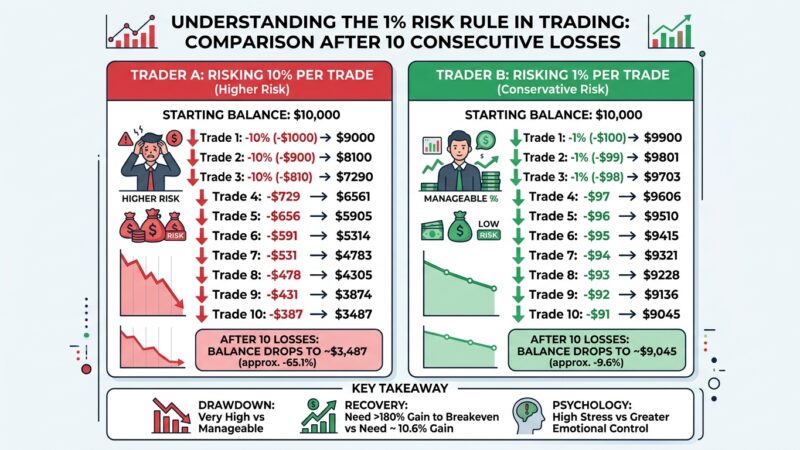
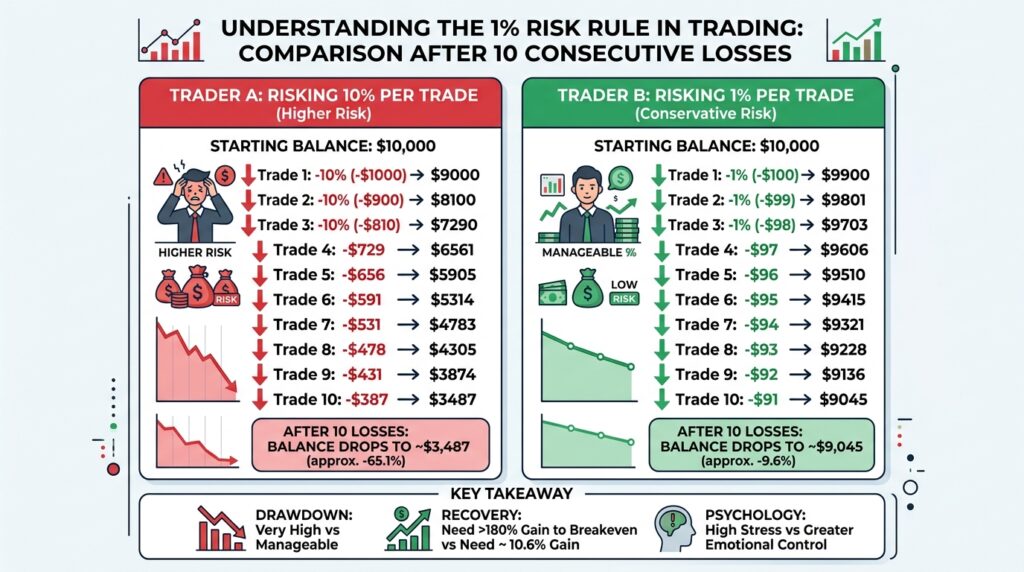
Even if you lose 10 consecutive trades in a row — which is statistically possible even with a good strategy — you have only lost 10% of your account. Your account is still 90% intact. You can continue trading. You can recover.
Without this rule, 10 consecutive losses at 10% risk per trade would wipe your account completely. With the 1% rule, 10 consecutive losses are painful but survivable.
That survivability is the entire point.
Why Most Traders Ignore Position Sizing — And Pay the Price
There are three main reasons traders skip proper position sizing:
Overconfidence in the setup. When a trader is very confident about a trade, they increase their position size dramatically. “This one is a sure thing.” The market has humbled every trader who has ever said those words. No trade is a sure thing. Ever.
Impatience with small gains. Proper position sizing with 1% risk produces modest gains on individual trades. This feels frustratingly slow for beginners who want to double their account quickly. But the traders who try to grow fast are exactly the ones who go to zero fast.
No awareness that position sizing exists. Many beginners simply do not know this concept. They were never taught it. They open a trading account, deposit money, and start buying shares without any framework for how much to buy. This is trading blind.
The Position Sizing Formula — Manual Calculation
Before building the Excel template, understand the formula. It is simpler than it looks.
Step 1 — Calculate your Rupee Risk per Trade
Rupee Risk = Account Size × Risk PercentageExample: ₹1,00,000 account × 1% = ₹1,000 maximum risk per trade
Step 2 — Calculate your Risk Per Share
Risk Per Share = Entry Price − Stop Loss PriceExample: You want to buy a stock at ₹500. Your stop loss is at ₹480. Risk Per Share = ₹500 − ₹480 = ₹20 per share
Step 3 — Calculate your Position Size
Position Size = Rupee Risk ÷ Risk Per ShareExample: ₹1,000 ÷ ₹20 = 50 shares
So with a ₹1,00,000 account, buying a stock at ₹500 with a stop loss at ₹480 — you should buy exactly 50 shares. Not 100. Not 200. Not however many you can afford. Exactly 50 — because that is the number that keeps your risk at 1%.
Total Capital Used: 50 × ₹500 = ₹25,000 Maximum Loss if Stop Loss Hits: 50 × ₹20 = ₹1,000 = exactly 1% of account ✅
Let Us Try More Examples
Example 1 — Small Account
- Account Size: ₹50,000
- Risk: 1% = ₹500
- Entry Price: ₹200
- Stop Loss: ₹190
- Risk Per Share: ₹10
- Position Size: ₹500 ÷ ₹10 = 50 shares
- Capital Used: 50 × ₹200 = ₹10,000
Example 2 — Tight Stop Loss
- Account Size: ₹1,00,000
- Risk: 1% = ₹1,000
- Entry Price: ₹1,500
- Stop Loss: ₹1,470
- Risk Per Share: ₹30
- Position Size: ₹1,000 ÷ ₹30 = 33 shares
- Capital Used: 33 × ₹1,500 = ₹49,500
Example 3 — Wide Stop Loss
- Account Size: ₹1,00,000
- Risk: 1% = ₹1,000
- Entry Price: ₹1,500
- Stop Loss: ₹1,400
- Risk Per Share: ₹100
- Position Size: ₹1,000 ÷ ₹100 = 10 shares
- Capital Used: 10 × ₹1,500 = ₹15,000
Notice what happened in Example 3 — a wider stop loss forces a smaller position size. This is the formula protecting you automatically. When your stop is far away, the formula tells you to buy fewer shares. When your stop is tight, you can buy more shares. The risk stays constant at 1% regardless.
This is the power of position sizing.
How to Build Your Position Sizing Calculator in Excel — Step by Step
You do not need any advanced Excel knowledge for this. Follow these exact steps.
Step 1 — Open a New Excel Sheet or Google Sheet
Google Sheets is recommended because it is free and accessible from any device including your phone — which means you can calculate position size on the go before placing any trade.
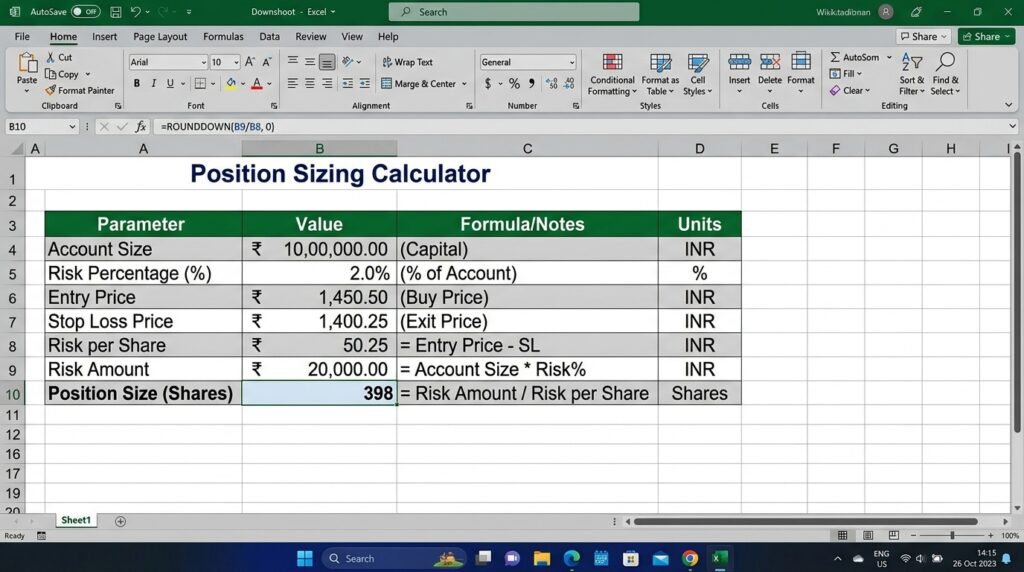
Step 2 — Create These Rows
Set up your sheet exactly like this:
| Row | Column A (Label) | Column B (Value) |
|---|---|---|
| 1 | Account Size (₹) | 100000 |
| 2 | Risk Percentage (%) | 1 |
| 3 | Entry Price (₹) | 500 |
| 4 | Stop Loss Price (₹) | 480 |
| 5 | Rupee Risk (₹) | =B1*B2/100 |
| 6 | Risk Per Share (₹) | =B3-B4 |
| 7 | Position Size (Shares) | =INT(B5/B6) |
| 8 | Capital Required (₹) | =B7*B3 |
| 9 | % of Capital Used | =B8/B1*100 |
Step 3 — Enter Your Formulas
In Column B, rows 5 through 9, enter these formulas exactly:
- B5 →
=B1*B2/100(calculates your rupee risk) - B6 →
=B3-B4(calculates risk per share) - B7 →
=INT(B5/B6)(calculates position size, INT rounds down to whole shares) - B8 →
=B7*B3(calculates total capital required) - B9 →
=B8/B1*100(shows what % of your account this trade uses)
Step 4 — Format for Clarity
- Make Row 5 through 9 bold with a light blue background so results stand out
- Format Column B as currency (₹) for rows 1, 3, 4, 5, 6, 8
- Format B2 and B9 as percentage
- Add a title at the top: “Position Sizing Calculator — TradeSmarty”
Step 5 — How to Use It Before Every Trade
Every time you identify a trade setup, before placing the order:
- Open your Excel/Google Sheet
- Confirm your account size in B1
- Keep B2 at 1% (only change this if you have a specific reason)
- Enter your planned entry price in B3
- Enter your planned stop loss in B4
- Read the Position Size from B7
- Place your order for exactly that many shares
This takes less than 60 seconds. And it ensures that every single trade you take has exactly 1% risk — no more, no less.
Advanced Version — Multiple Risk Levels
Once you are comfortable with the basic template, you can create an advanced version that shows position sizes for different risk levels simultaneously — so you can choose based on your conviction level.
Add these additional columns:
| Risk Level | Formula |
|---|---|
| 0.5% Risk — Shares | =INT((B1*0.5/100)/B6) |
| 1% Risk — Shares | =INT((B1*1/100)/B6) |
| 1.5% Risk — Shares | =INT((B1*1.5/100)/B6) |
| 2% Risk — Shares | =INT((B1*2/100)/B6) |
This gives you a quick reference table. For high-confidence setups you might use 1.5%. For uncertain market conditions you might use 0.5%. But you should never go above 2% per trade — regardless of confidence level.
Position Sizing for F&O Traders
If you trade Futures and Options, position sizing works slightly differently but the principle is identical.
For Futures:
- Your risk is the distance from entry to stop loss multiplied by lot size
- Example: Nifty futures, entry at 22,000, stop at 21,950, lot size 25
- Risk per lot = 50 points × 25 = ₹1,250
- If your 1% risk on ₹2,00,000 account = ₹2,000
- Position size = ₹2,000 ÷ ₹1,250 = 1 lot (round down always)
For Options Buying:
- Many option buyers use a simpler rule: never spend more than 1-2% of capital on a single option premium
- Example: ₹1,00,000 account → maximum ₹1,000 to ₹2,000 on any single options trade
- This automatically limits your loss to the premium paid

Common Position Sizing Mistakes to Avoid
Mistake 1 — Changing risk percentage based on emotion When you feel very confident, the temptation is to risk 5% or 10% on “the sure trade.” Resist this completely. The 1% rule exists precisely because no trade is ever sure.
Mistake 2 — Ignoring brokerage in calculations For very small position sizes or high brokerage structures, transaction costs can eat significantly into your risk-reward ratio. Factor brokerage into your calculations especially when trading smaller accounts.
Mistake 3 — Using the same position size for every trade Your position size should change every trade based on stop loss distance. A trade with a tight stop allows more shares. A trade with a wide stop requires fewer shares. This is the entire point of the formula.
Mistake 4 — Rounding up instead of down Always use INT function in Excel which rounds down to the nearest whole share. Never round up. Rounding up increases your risk beyond 1%. Always stay at or below your risk limit — never above.
Mistake 5 — Not updating account size regularly As your account grows or shrinks, your rupee risk per trade changes. Update your account size in the calculator at the start of each month at minimum — or after any significant change in capital.
The Psychological Benefit of Position Sizing
Here is something that surprises many traders when they first start using proper position sizing: it dramatically reduces trading anxiety.
When you know that the absolute maximum you can lose on any trade is 1% of your account — and you have accepted that loss as the cost of the trade — the emotional intensity of watching price movement decreases significantly.
You are no longer sitting at your screen praying the trade works because too much is riding on it. You know exactly what you risked. You have already mentally accepted that loss as a possible outcome. This acceptance creates the psychological space to make clear, rational decisions during the trade.
Position sizing does not just protect your account financially. It protects your mind emotionally. And in trading, your mind is your most important asset.
Final Thoughts
The position sizing calculator is not a glamorous tool. It does not predict market direction. It does not find the perfect entry. It does not guarantee profits.
What it does is guarantee that no single trade — no matter how wrong — can seriously damage your account or your ability to continue trading.
That protection, practiced consistently over hundreds of trades, is what allows a good strategy to actually show its edge over time. Without position sizing, even the best strategy in the world will eventually produce a trade large enough to cause irreversible damage.
Build your Excel template today. Use it before every single trade. Make it as automatic and non-negotiable as placing a stop loss.
This one habit — more than any indicator, more than any strategy — will define the long-term trajectory of your trading career.