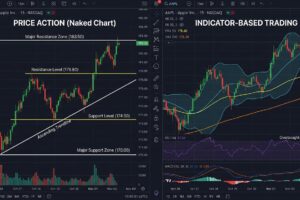
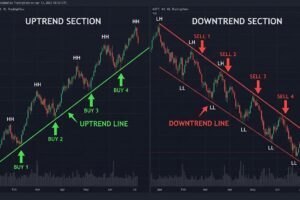
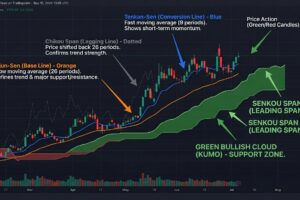
Many beginners believe that indicators are secret tools that guarantee profits. When losses happen, they blame the indicator instead of understanding indicator misuse in trading. The reality is simple: indicators do not fail—the way traders use them fails.
Indicators are support tools, not decision-makers. This article explains how indicators are misused by beginners, why that leads to losses, and how indicators should actually be used in real trading.

What Are Indicators?
Indicators are mathematical calculations based on price, volume, or time. They help traders understand market behavior, not predict the future.
Common indicators include:
- Moving Averages
- RSI
- MACD
- Bollinger Bands
- Stochastic Oscillator
Indicators react to price, they do not lead price.
The Biggest Truth About Indicators
Indicators are lagging tools. They work on past data.
This means:
- Indicators confirm moves
- They do not predict reversals
- They reduce uncertainty, not risk
Beginners often expect indicators to give perfect buy and sell signals, which leads to misuse.
How Indicator Misuse Happens (Real Reasons)
Understanding indicator misuse in trading requires understanding trader behavior.
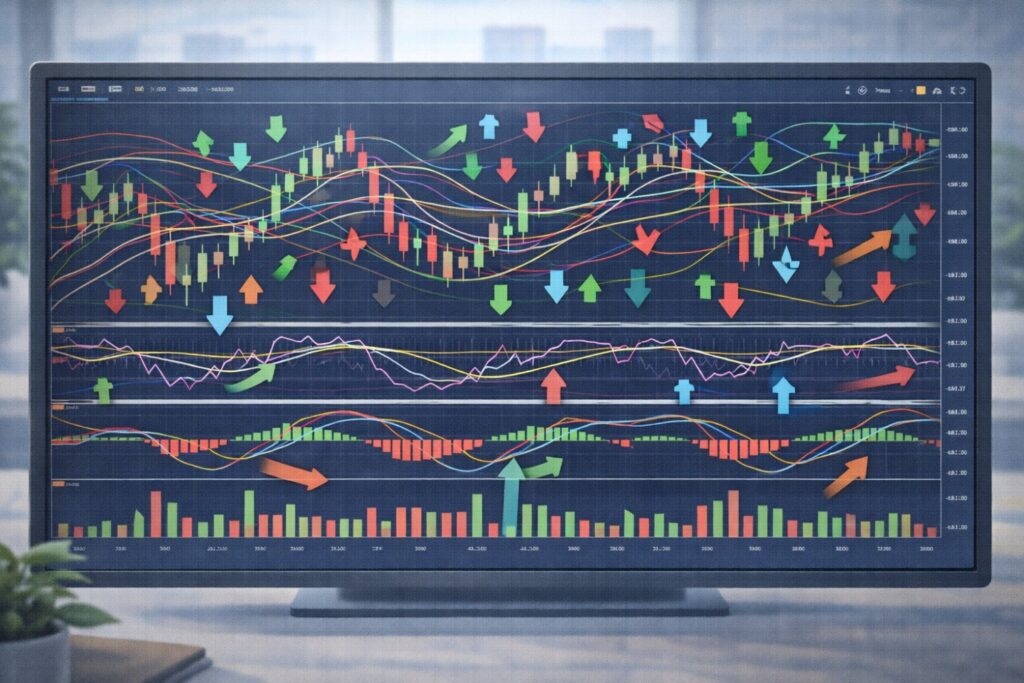
1. Using Too Many Indicators at Once
One of the most common mistakes is indicator overload.
Beginners add:
- RSI
- MACD
- Moving averages
- Stochastic
- Bollinger Bands
All on one chart.
Result:
- Conflicting signals
- Confusion
- Late entries
- Emotional decisions
More indicators do not mean more accuracy.
2. Blindly Following Buy/Sell Signals
Many beginners:
- Buy when indicator shows “Buy”
- Sell when indicator shows “Sell”
Without checking:
- Trend direction
- Support and resistance
- Market structure
Indicators generate signals in all market conditions, but not all conditions are tradable.
3. Ignoring Price Action
Price is the most important information on the chart.
Indicator misuse happens when traders:
- Ignore candlestick structure
- Ignore market trend
- Ignore key levels
Indicators should support price action, not replace it.
4. Expecting Indicators to Predict the Market
Beginners often believe:
- RSI oversold = price must go up
- RSI overbought = price must fall
This is wrong.
Markets can remain:
- Overbought for long time
- Oversold for long time
Indicators show conditions, not turning points.
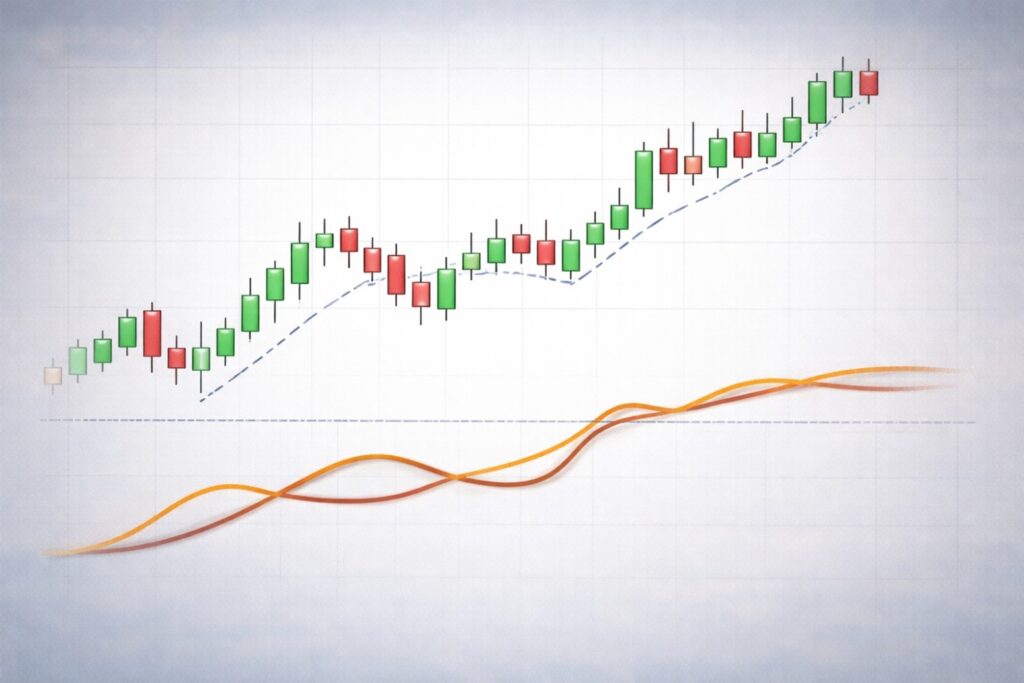
5. Using Indicators Without Context
Indicators behave differently in:
- Trending markets
- Sideways markets
- Volatile markets
Using the same indicator settings everywhere leads to losses.
Example:
- RSI works differently in strong trends
- MACD gives false signals in ranges
Context matters more than the indicator.
6. Changing Indicators After Every Loss
After a loss, beginners often:
- Change indicator
- Change settings
- Add another indicator
This creates:
- No consistency
- No learning
- Repeated losses
Losses are part of trading. Indicators should not be changed impulsively.
7. Using Indicators on Very Small Timeframes
Lower timeframes:
- Have more noise
- Produce more false signals
- Increase emotional pressure
Beginners misuse indicators by:
- Trading on 1-minute charts
- Taking too many signals
Indicators work better on higher timeframes.
For official investor education and trading awareness, visit the official SEBI website.
Why Indicators Appear to Work on Social Media
On social media:
- Only winning trades are shown
- Losses are hidden
- Charts are cherry-picked
This creates false belief that indicators alone make money.
Real trading includes losses.
How to Use Indicators Correctly (Real Use)
Indicators should be used as confirmation tools, not decision tools.
Correct approach:
- Identify trend using price
- Mark support and resistance
- Use indicator for confirmation
- Manage risk properly
Indicators answer “Is momentum supporting my idea?”
Best Way for Beginners to Use Indicators
Beginners should:
- Use maximum 1–2 indicators
- Understand indicator logic
- Combine with price action
- Focus on risk management
Example:
- Trend → Moving Average
- Momentum → RSI
- Entry → Price action
Indicators That Are Commonly Misused
- RSI (overbought/oversold misunderstanding)
- MACD (late signals)
- Stochastic (noise on low TF)
- Bollinger Bands (false breakouts)
Indicators are not bad. Misuse is the problem.
Can Profitable Traders Trade Without Indicators?
Yes.
Many professional traders:
- Use price action only
- Or use very few indicators
Indicators are optional tools, not mandatory requirements.
Reality Check for Beginners
Indicators:
- Do not guarantee profit
- Do not eliminate losses
- Do not replace discipline
Trading success depends more on:
- Risk management
- Psychology
- Consistency
Final Conclusion
Indicator misuse in trading is one of the biggest reasons beginners lose money. Indicators are not wrong, but expecting them to predict the market is wrong.
Use indicators as supporting tools, not decision-makers. Focus on price, structure, and risk management first. When indicators are used correctly, they help. When misused, they harm.