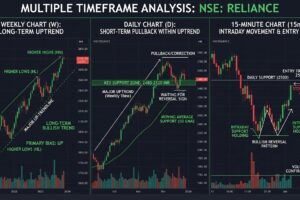
The intraday trading process is often misunderstood by beginners. Many people enter intraday trading after watching social media videos or seeing screenshots of quick profits, without understanding how the process actually works. As a result, they face losses and frustration.
Intraday trading is not gambling, but it is also not easy money. It follows a clear process that professional traders follow every single day. This article explains the complete intraday trading process step by step, in simple English, so beginners can understand how intraday trading is actually done.

What Is Intraday Trading?
Intraday trading means buying and selling a stock on the same trading day. No position is carried overnight. All trades must be closed before the market closes.
Key points:
- Trades happen within market hours
- No overnight risk
- Focus on small price movements
- Requires discipline and speed
Intraday trading is different from investing, where stocks are held for months or years.
Step 1: Pre-Market Preparation (Most Important Step)
The intraday trading process starts before the market opens, not after.
A professional trader prepares by:
- Checking global market trends
- Reading major news
- Reviewing previous day’s market movement
- Identifying important levels
Beginners often skip this step, which leads to random trades.
What to check in pre-market:
- Gift Nifty / global indices direction
- Major news (results, RBI, inflation, global events)
- Stocks with high volume or news impact
Good preparation reduces impulsive decisions.
Step 2: Selecting the Right Stocks for Intraday
Not every stock is suitable for intraday trading.
Good intraday stocks usually have:
- High liquidity
- High volume
- Clear price movement
- Tight bid-ask spread
Avoid:
- Low-volume stocks
- Penny stocks
- Stocks with unpredictable movement
Beginners should focus on 5–10 stocks maximum, not the entire market.
Step 3: Choosing the Right Time Frame
Time frame selection is a key part of the intraday trading process.
Common time frames:
- 5-minute chart (most popular)
- 15-minute chart (better for beginners)
- 1-minute chart (high risk)
For beginners:
- Use 15-minute chart for trend
- Use 5-minute chart for entry
Lower time frames increase noise and emotional pressure.
Step 4: Identifying Market Direction
Before placing any trade, you must know:
- Is the market bullish?
- Is it bearish?
- Is it sideways?
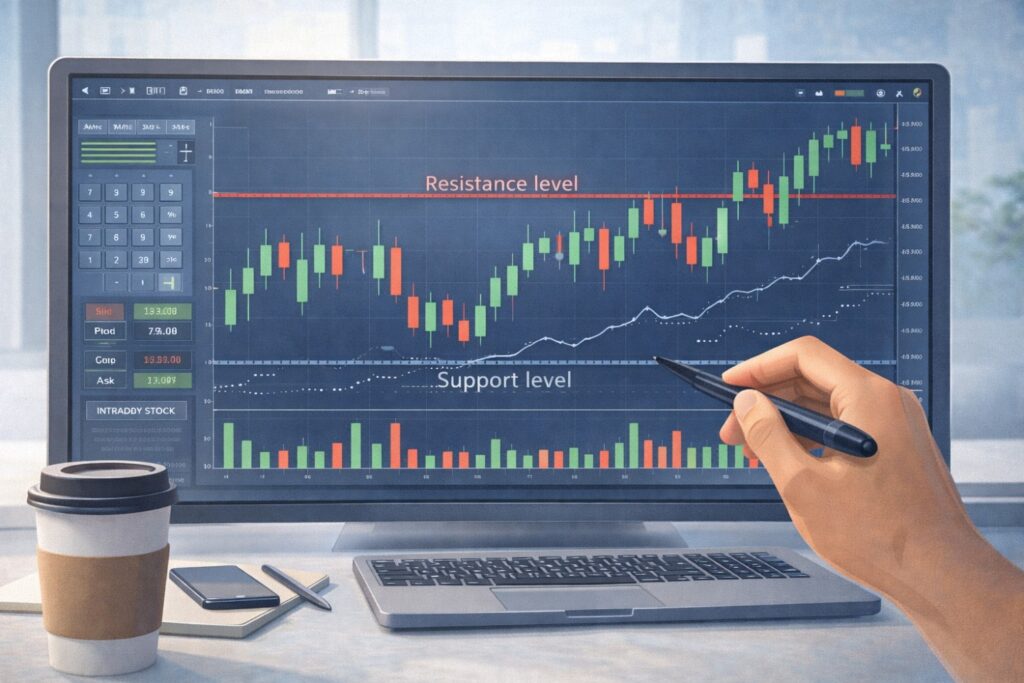
Ways to identify direction:
- Trend lines
- Support and resistance
- VWAP
- Moving averages
Trading without knowing market direction is one of the biggest beginner mistakes.
For official information on stock market trading rules, visit the official NSE website.
Step 5: Trade Setup Formation
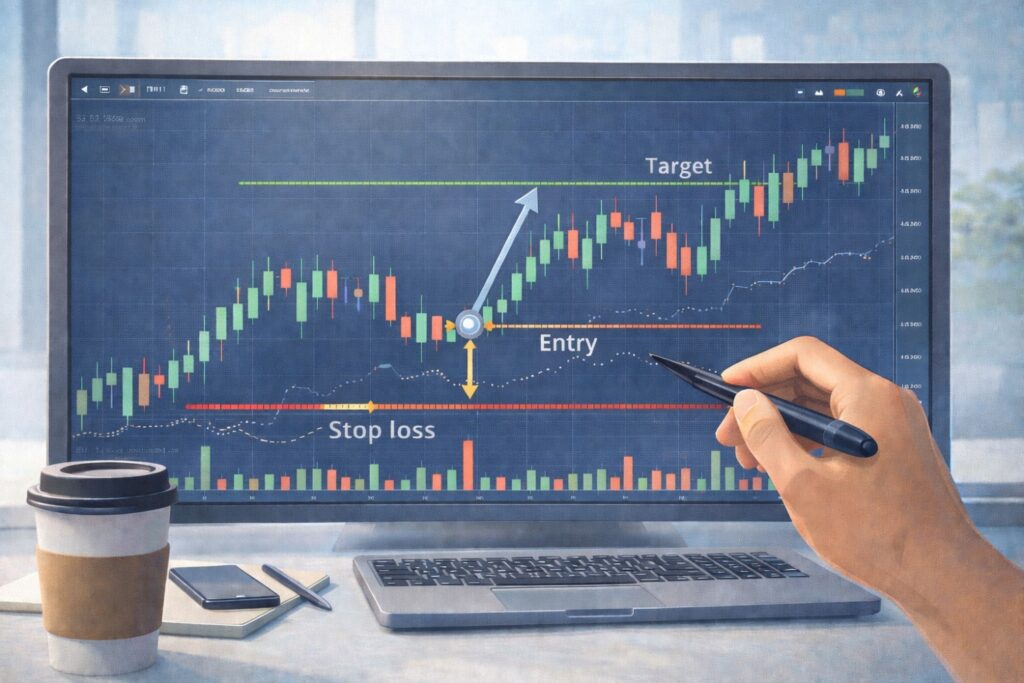
A trade setup means clear rules for entry, stop loss, and target.
A valid intraday trade setup includes:
- Entry price
- Stop loss level
- Target price
- Risk-reward ratio
Never enter a trade without a predefined stop loss.
Step 6: Entry Execution
Once your setup is ready, enter the trade only when conditions are met.
Rules for entry:
- Do not chase price
- Enter near support or resistance
- Follow your setup strictly
- Avoid emotional entries
Many beginners enter trades late, which increases risk and reduces reward.
Step 7: Stop Loss Placement (Non-Negotiable)
Stop loss is the backbone of the intraday trading process.
Why stop loss is mandatory:
- Protects capital
- Controls losses
- Reduces emotional stress
Rules:
- Stop loss should be placed immediately
- Never move stop loss emotionally
- Risk only 1–2% of capital per trade
A trader without stop loss is not a trader, but a gambler.
Step 8: Target Setting
Targets should be realistic and based on:
- Support and resistance
- Risk-reward ratio
- Market volatility
Ideal risk-reward ratio:
- Minimum 1:1.5
- Better: 1:2
Do not expect huge moves every day. Small consistent profits matter more.
Step 9: Trade Management
Trade management is what separates professionals from beginners.
Good trade management includes:
- Trailing stop loss
- Partial profit booking
- Closing trade if setup fails
Avoid:
- Over-monitoring every tick
- Panic exits
- Greed-based holding
Step 10: Exit Before Market Close
Intraday trades must be closed before market close.
Holding intraday positions overnight:
- Converts trade into delivery
- Exposes you to overnight risk
- Can cause unexpected losses
Always square off trades before the closing bell.
Step 11: Post-Market Analysis
The intraday trading process does not end after market close.
Post-market review includes:
- Reviewing trades taken
- Analyzing mistakes
- Checking rule violations
- Updating trading journal
This step improves performance over time.
Risk Management in Intraday Trading
Risk management is more important than strategy.
Golden rules:
- Fixed daily loss limit
- Maximum 2–3 trades per day
- Avoid revenge trading
- Stop trading after hitting loss limit
Survival comes before profit.
Common Beginner Mistakes in Intraday Trading
- Trading without a plan
- Overtrading
- Ignoring stop loss
- Trading based on tips
- Expecting daily income
Avoiding these mistakes improves long-term survival.
Is Intraday Trading Suitable for Beginners?
Intraday trading is not ideal for absolute beginners.
Beginners should:
- First understand market basics
- Learn price behavior
- Start with paper trading
- Trade with small capital
Jumping directly into intraday trading with high expectations often leads to losses.
Final Conclusion
The intraday trading process is structured, disciplined, and rule-based. It is not about prediction but about probability, risk control, and execution.
Intraday trading can be profitable only when done with:
- Proper preparation
- Clear setups
- Strict risk management
- Emotional discipline
If you are a beginner, learn the process first. Profit will come later.