Walk into any trading community in India — a Telegram group, a YouTube comment section, a trading forum — and you will find this debate happening constantly:
“Price action is the only real trading. Indicators are lagging, useless noise.”
“Price action is too subjective. You need indicators to get objective signals.”
Both sides argue passionately. Both sides have traders who make money using their preferred approach. And both sides fundamentally misunderstand what the debate is actually about.
Price action vs indicators is not a competition where one side wins and the other is wrong. It is a question of understanding — understanding what each approach measures, what each one does well, where each one fails, and how to intelligently combine them or choose between them based on your trading style and market conditions.
This article gives you that understanding completely — so you can stop arguing about which is better and start using whichever approach, or combination, that actually fits your trading.
What Is Price Action Trading?
Price action trading means making all trading decisions based purely on what price itself is doing — without any mathematical indicators applied to the chart.
A price action trader reads:
- Candlestick patterns — The shape, size, and relationship of individual candles and candle combinations that reveal buying and selling pressure
- Support and resistance levels — Horizontal price zones where buying or selling has repeatedly appeared
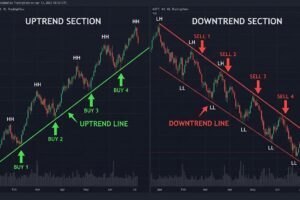
- Trendlines and channels — The directional structure of price movement
- Chart patterns — Formations like head and shoulders, double tops, triangles, and flags that represent recognizable supply and demand dynamics
- Market structure — The sequence of highs and lows that defines trend direction and strength
A price action trader’s chart is clean — often called a “naked chart” — with nothing on it except price candles, maybe a few drawn lines, and no colored indicators overlaid or underneath.
The philosophy behind price action trading is simple: price is the only truth. Every piece of information that affects a stock — earnings, news, institutional positioning, global events — is ultimately reflected in price. Reading price directly means reading all of that information simultaneously, without the delay and distortion that mathematical indicators introduce.
What Are Indicators and Why Were They Created?
Indicators are mathematical formulas applied to price data — usually involving some form of averaging, rate of change measurement, or statistical calculation — that produce a visual output designed to make some aspect of price behavior more visible or objective.
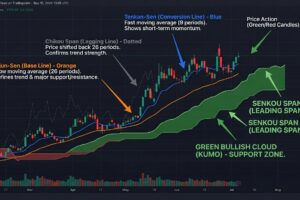
Common indicators used by Indian traders include Moving Averages, RSI, MACD, Bollinger Bands, ADX, Stochastic, and Supertrend among many others.
Indicators were originally created to solve a specific problem: human beings are inconsistent and emotional readers of raw charts. Two traders looking at the same naked chart might reach completely different conclusions. An indicator applies the same mathematical formula to every bar of price data — producing consistent, repeatable, emotion-free readings.
The philosophy behind indicator-based trading is: objectivity reduces errors. By converting subjective chart reading into mathematical output, indicators aim to remove emotional interpretation and provide clear, unambiguous signals.

The Core Argument for Price Action — Why Naked Charts Work
1. Indicators Are Derived From Price — Price Is the Source
This is the most fundamental argument for price action trading and it is logically airtight.
Every indicator — without exception — is calculated from price data. RSI uses closing prices. MACD uses exponential moving averages of closing prices. Bollinger Bands use price averages and standard deviations. ADX uses price highs and lows.
If all indicators are derived from price — then price contains all the information that any indicator can show you. The indicator is simply a mathematical transformation of what is already visible in price itself.
A skilled price action reader is going directly to the source. An indicator user is reading a processed version of the same information — with the inevitable delay that mathematical processing introduces.
2. No Lag — Price Action Is Real Time
All indicators based on moving averages or averaging calculations have inherent lag — they reflect past price behavior, not current price reality. A 20-period moving average is the average of the last 20 closes — by definition it is always behind current price.
This lag matters enormously in fast-moving markets. By the time a lagging indicator signals a trend change on Nifty — the move may already be 50 to 100 points advanced. Price action traders who read the candlestick patterns and structural shifts directly see the change happening in real time — not after the moving average catches up.
3. Adaptability to Market Conditions
Price action adapts automatically to changing market conditions. A pin bar forms regardless of whether the market is trending or ranging. A support break is a support break regardless of what the indicator says.
Indicators optimized for trending markets fail in ranging markets. Indicators optimized for ranging markets generate false signals in trends. Price action simply reflects whatever the market is doing — the trader interprets it in context.
4. No Indicator Overload or Conflicting Signals
A common problem for indicator traders is conflicting signals — RSI says oversold, MACD says bearish, Supertrend says sell. Which do you follow? This paralysis by analysis is a direct consequence of multiple indicators generating inconsistent readings.
A naked chart has no such conflict. Price either broke support or it did not. The candle either shows a reversal pattern or it does not. The structure is either making higher highs or it is not. Price action creates clarity — not confusion.
The Core Argument for Indicators — Why They Add Value
1. Objectivity and Consistency
The biggest weakness of pure price action trading is subjectivity. Ask five experienced price action traders whether a particular candlestick pattern is a valid pin bar — and you may get five different answers. Ask them to draw support and resistance on the same chart — and you will get five different drawings.
Indicators eliminate this subjectivity. RSI at 72 is RSI at 72 — there is no interpretation required. ADX at 28 means a trend exists — period. This objectivity is particularly valuable for newer traders who have not yet developed the visual pattern recognition that experienced price action traders rely on.
2. Quantifiable and Backtestable
Indicator-based strategies can be precisely defined and backtested on historical data. You can test whether “buy when RSI crosses above 30 with ADX above 25” has been profitable over 500 trades on Nifty data — and get a statistically meaningful answer.
Pure price action strategies are much harder to backtest precisely because the signal definitions involve subjective judgment — “a valid hammer at support” requires a human to define what “valid” means for every historical example.
The ability to backtest and quantify allows indicator traders to know their strategy’s win rate, average risk-reward, maximum drawdown, and expectancy before trading it live. This knowledge is powerful for building realistic expectations and appropriate position sizing.
3. Momentum and Divergence Visibility
Certain market conditions are genuinely easier to see with indicators than without them.
RSI divergence — where price makes a new high but RSI makes a lower high — is a signal of weakening momentum that can be difficult to read from price candles alone. The divergence is immediately visible on the RSI line.
MACD histogram changes — where the histogram bars are shrinking while price is still moving in the trend direction — visually represent momentum deterioration that is subtle in raw price but clear in the indicator.
These momentum insights genuinely add information that complements what the naked chart shows.
4. Discipline for Emotional Traders
For traders who struggle with emotional decision-making — the structure of a rule-based indicator system provides discipline that pure price action cannot. When the rule is “only enter when RSI crosses above 50 and price is above 200 EMA” — there is no room for emotional overrides. The rule is either met or it is not.
This structured approach prevents the impulsive entries and exits that destroy accounts — particularly for newer traders who have not yet developed the emotional discipline that pure price action trading demands.
Where Price Action Fails
Price action trading is not without genuine weaknesses that every honest price action trader should acknowledge.
High subjectivity in learning curve. Developing reliable price action reading skills takes years of screen time and pattern recognition development. A beginner applying price action without the necessary experience will be highly inconsistent — seeing patterns that are not there and missing patterns that are.
Difficult in highly news-driven environments. When markets gap on news — earnings surprises, RBI decisions, global events — price action patterns formed before the gap have limited relevance. The naked chart cannot show you what the news catalyst is doing to market sentiment. Fundamental context matters and pure price action ignores it entirely.
Risk of confirmation bias. Because price action is interpretive, traders often see what they want to see. A trader biased toward a long position will interpret an ambiguous candle as a bullish signal. An indicator gives the same reading regardless of the trader’s bias.
Where Indicators Fail
Indicators have equally significant limitations that indicator-dependent traders must understand.
Lag makes entries late and exits late. In fast-moving markets — a Nifty budget day move, a sudden FII selling event — lagging indicators are essentially useless for timing. By the time the signal fires, the optimal entry has passed or the optimal exit has passed.
Overfitting and optimization trap. Indicators can be optimized to work perfectly on historical data and fail completely on live data. This curve-fitting problem destroys many indicator-based systems that looked excellent in backtesting but never worked in real trading.
False signals in ranging markets. Most trend-following indicators — moving averages, MACD, Supertrend — generate repeated false signals in sideways markets. These periods of choppy price action can produce long sequences of losing signals that erode confidence and capital before the next genuine trend begins.
Indicator overload destroys clarity. More indicators do not mean more information — they mean more noise and more conflicting signals. A chart with 6 indicators is not 6 times more informative. It is 6 times more confusing.

When to Trust the Naked Chart — Specific Situations
There are specific market situations where price action alone is clearly superior to indicator-based approaches.
At Key Support and Resistance Levels
When price arrives at a major horizontal support or resistance level — a level that has been respected multiple times over months — the most important information is what the candlestick pattern looks like at that level. Is there a pin bar showing rejection? A bullish engulfing showing absorption of selling? A doji showing indecision?
No indicator adds more information here than the candlestick itself. The candle at the level is the signal. An RSI reading or MACD crossover is secondary and often irrelevant.
During News Events and Gap Openings
When Nifty gaps up or down significantly on news — price action context of the gap is far more useful than any indicator. Is the gap into resistance? Is the gap filling immediately — suggesting false breakout? Is price finding support at the gap level — suggesting genuine breakout?
Indicators calculated from pre-gap data are essentially blind to what the gap itself means. Price structure around the gap tells you the story directly.
In Clear Trending Markets
In a strong, clean trend — the naked chart shows you everything you need. Price is making higher highs and higher lows. Pullbacks to the trendline or moving average are buy opportunities. The trend is visible without any indicator.
Adding indicators to a clearly trending chart often creates confusion — RSI becomes overbought early in a strong trend and would have you selling far too soon.
For Reading Market Structure on Higher Timeframes
Understanding whether the weekly or monthly chart is in a bull market or bear market — whether the structure is intact or breaking down — is best done on a clean naked chart. The sequence of swing highs and lows over months or years tells you the macro structure with complete clarity. Indicators on a weekly chart add little to this structural reading.
When to Use Indicators — Specific Situations
For Measuring Momentum and Divergence
RSI and MACD divergence — where momentum is weakening while price continues in the trend direction — is genuinely easier to see with the indicator than on the naked chart alone. Using RSI specifically for divergence identification while keeping the chart otherwise clean is one of the most intelligent uses of indicators.
For Measuring Volatility
ATR and Bollinger Bands measure volatility in ways that are difficult to assess visually on a naked chart. Using these specifically for stop loss sizing and position sizing calculations — rather than for entry signals — adds genuine value that price action alone cannot provide.
For Filtering Market Conditions
ADX used specifically to determine whether the market is trending or ranging — as discussed in the previous article — is a legitimate indicator application that helps you apply the right strategy for the current environment. This is using an indicator as a context filter rather than a signal generator.
For Objective Confirmation in Early Trading
For traders in the early stages of their development who have not yet built reliable price action reading skills — a simple indicator like the 200 EMA for trend direction or RSI for momentum confirmation provides a training-wheel structure that prevents the worst emotional decisions while skills develop.
The Professional Approach — How Experienced Traders Actually Use Both
Here is the reality that most trading content does not acknowledge: the best traders do not choose exclusively between price action and indicators. They use price action as primary and indicators as secondary confirmation — selectively and specifically.
The hierarchy looks like this:
Primary — Price Structure and Candlesticks What is the overall market structure? Uptrend, downtrend, or range? What is the candlestick pattern at the key level? Is there a clear signal in price itself?
Secondary — One or Two Specific Indicators for Specific Purposes Is ADX above 25 confirming that a trend exists? Is RSI showing divergence that warns of momentum weakness? Is ATR telling me how wide my stop loss should be?
The indicators are not generating the trade idea. The price action is generating the trade idea. The indicators are confirming or filtering it.
A specific example: You see price pulling back to a major trendline support on Nifty daily chart. A hammer candlestick forms at the trendline — this is your primary signal from price action. You then check RSI — it is at 45 and turning upward, not showing divergence. You check ADX — it is at 28, confirming a trend exists. Both indicators confirm what price action already told you.
You enter the trade. The price action gave the signal. The indicators gave the confidence.
This is not indicator trading. It is not pure price action trading. It is intelligent, hierarchical use of both tools — with price action always in the driver’s seat.
Building Your Own Approach — A Practical Framework
Here is how to decide what balance of price action and indicators is right for you specifically.
If you are a complete beginner — Start with one indicator for trend direction (200 EMA — price above means bullish, below means bearish) and one for momentum confirmation (RSI). Keep your chart otherwise clean. Learn to read basic candlestick patterns at the same time. This combination gives you structure while you develop visual skills.
If you have 6 to 12 months of experience — Remove one indicator and replace its function with a price action equivalent. Instead of MACD for trend direction — read the swing high and swing low structure directly. Keep RSI specifically for divergence identification. Increase your focus on candlestick patterns at key levels.
If you have 1 to 2 years of experience — Your chart should be approaching mostly clean. Use price structure, candlesticks, support resistance, and trendlines as primary tools. Keep ATR for stop loss sizing. Keep ADX as a market condition filter. Remove everything else.
If you have developed reliable pattern recognition — Trade the naked chart with only horizontal levels and trendlines. Use ATR for position sizing only. Trust your price reading.
The journey from indicator-heavy to price action primary is gradual — not an overnight switch. Each stage of removing indicators should happen only when you have genuinely replaced their function with price reading skill, not simply removed their visual clutter.

The One Rule That Settles the Debate
If you take nothing else from this article — take this single rule that cuts through the entire price action vs indicators debate:
Never use an indicator to override what price is clearly telling you.
If price has broken a major support level with a strong bearish candle and high volume — but your moving average has not crossed yet — believe the price. The indicator is lagging. Price already told you what happened.
If price forms a clear rejection pin bar at a major resistance level — but RSI is not yet overbought — believe the price. RSI does not need to be overbought for a reversal to begin.
Indicators confirm price. They do not override it. The moment you start ignoring clear price signals because an indicator disagrees — you have inverted the hierarchy. You are now trusting a mathematical formula derived from price more than you trust price itself.
Price is always first. Everything else — every indicator, every signal, every system — is secondary to what price is actually doing right now.
Final Thoughts
The price action vs indicators debate has no winner because it asks the wrong question. The right question is not which is better — it is which is appropriate for your current skill level, your trading style, and the current market condition.
Use indicators intelligently — as filters and confirmations, not as primary signal generators. Read price action as your primary skill — the foundation that no indicator can replace. Combine them with a clear hierarchy where price action leads and indicators support.
And above all — keep your charts clean. A cluttered chart full of conflicting indicators is not sophisticated analysis. It is noise masquerading as information.
The best trade setups are always obvious on a clean chart. If you need five indicators to justify an entry — the entry is not there.
Trust the price. Read the structure. Use tools sparingly and specifically. That is how the best traders in the world actually trade — regardless of which side of this debate they claim to be on.